- 37.1 What are requirements?
- 37.1.1 Why write requirements?
- 37.1.2 What are requirements about?
- 37.1.3 The context for requirements
- 37.2 A single requirement
- 37.2.1 Example
- 37.2.2 Rationale
- 37.3 Multiple requirements
- 37.4 Organizing requirements
- 37.4.1 Levels of requirements
- 37.4.2 Organizing by subject
- 37.4.3 Organizing by section
- 37.4.4 Hierarchical versus flat requirements
- 37.4.5 Requirement identifiers
- 37.5 Writing good requirements
- 37.5.1 General form
- 37.5.2 Single topic
- 37.5.3 Clarity about subject
- 37.5.4 Consistent language
- 37.5.5 Plain language
- 37.5.6 Negative requirements and “only”
- 37.5.7 Avoid “it”
- 37.5.8 Avoid impossibly high bars
- 37.5.9 Measurable conditions
- 37.5.10 Unverifiable conditions
- 37.5.11 Detail appropriate to the level
- 37.6 Requirement derivation
- 37.6.1 Subcomponents providing features for parent
- 37.6.2 Internal derivation
- 37.6.3 Pass through
- 37.6.4 Mutual dependency
- 37.6.5 Using derivation
- 37.6.6 Viewing derivation
- 37.7 Advanced requirements
- 37.7.1 Sets as subjects
- 37.7.2 Writing for standards
- 37.8 Analyzing requirements
- 37.8.1 Complete design
- 37.8.2 Minimal design
- 37.8.3 Consistency
- 37.8.4 Effects of changes
- 37.9 Validating requirements
- 37.9.1 Connecting requirements and implementation artifacts
- 37.10 Verification
- 37.11 Limitations of requirements
- 37.12 Working with requirements
- 37.12.1 Supporting the life cycle
- 37.12.2 Who works with requirements
- 37.13 Tools
37.1 What are requirements?
Requirements are one kind of specification: they say something about a property that a component or system should have, or a behavior they should exhibit.
A requirement is a specification in the form of a single, declarative textual statement. In the simplest case, a requirement is a statements of the form:
<thing> <specification mode verb, like “shall"> <do or exhibit something>
For example,
The encabulator shall be colored green.
There are many nuances and variations on this basic form, but they are all extensions of this basic idea.
Requirements are written this way in order to maximize the simplicity and clarity of the specification.
Requirements are only one part of the specification for a component or system. They document specific facts about a system’s design, but they do not document the explanation of how that particular design came to be. They do not document the general purpose and scope of a particular component. They do not document complex interaction patterns. These other parts of a specification are documented in other design artifacts that complement requirements.
37.1.1 Why write requirements?
One of the jobs of systems engineering is to ensure that a user or consumer of some artifact (system or component) will be satisfied with the artifact once it is built and deployed.
The specifications for a system or component serve as a way to organize the information about what the user wants, and to organize the process of checking that the final result meets the user’s desires. The specification thus acts as a kind of implicit contract between the end user and the implementers: if the user agrees that the specification properly records their objectives, and the resulting system can be verified to meet the specification, then then the implementers have built something that satisfies what the user agreed to. (Whether the user is actually satisfied is a separate matter.)
XXX would a couple diagrams help here? A first one might show user → conceptual artifact, conceptual artifact → developer → concrete artifact; a second one might show systems and verification in the picture?
This means that there are three main uses for requirements (and the rest of specifications):
- Encoding the user’s objectives in a written form, and allowing the user to validate that the specification matches what they want.
- Guiding implementers as they work out the design for the artifact that will meet the user’s objectives.
- Providing a checklist for verifying that the resulting artifact meets the specification, and thereby the user’s objectives.
A systems engineer is typically the keeper of the specifications, responsible for overseeing the writing, changing, and verification of requirements and other specifications.
Requirements—and all specifications—are therefore acts of communication between multiple groups of people with different roles in building the system.
Systems engineers are facilitators and interpreters in this communication between users and implementers. They are responsible for translating information received from users into specifications (including requirements), for explaining the specifications back to the users for validation. The information from the user is often unstructured and incomplete. It is up to the systems engineer to work with the user to clarify their objectives and ensure that the result accurately reflects the user’s intent. The systems engineer also works to ensure that the specifications are complete. This often involves identifying use cases that the user has not thought of themselves and working with the user to define what behavior the system should have in those other cases.
The systems engineer also facilitates the implementer’s work. The systems engineer develops specifications so that the implementer has a clear guide to what they need to design and build; this requires that the systems engineer provide translation or explanation when the specification does not use the same terms or concepts that the implementers do. The systems engineer is also responsible for ensuring that the final artifact meets the customer’s objectives by overseeing the verification of the implementation against requirements (and other specifications). This involves working with verifiers to ensure that verification methods match the requirements, and checking that all requirements have been verified before the system is declared done.
A systems engineer performs other tasks using requirements, such as checking consistency or completeness. We will discuss these tasks in a later section.
A good requirement must meet several objectives in order to provide accurate communication between all these parties:
- A requirement must be unambiguous. Each of the parties must be able to read the text of a requirement and have the same understanding of what it means.
- A requirement must have an unambiguous meaning about the system.Two people should be able to look at the system and read the requirement, and come to the same conclusion about how the system is supposed to behave if the system meets the requirement. Many people express this as “a requirement must be verifiable”.
- A requirement must be accurate. A requirement that misleads a reader has no point.
These needs lead to conventions about how requirements are written and organized, as we will discuss later.
37.1.2 What are requirements about?
Requirements are a general-purpose way of writing down facts about what something is supposed to be (or not be).
Requirements can apply to just about anything. In a typical system project, they will be used to:
- Record the objectives that end users have for the system as a whole
- Record the regulations and policies that people governing the system
- (or its market) impose on systems like this
- Record the behaviors and properties that individual components need
- to have on order to fit together into the system as a whole
- Record the processes that the system’s implementers must follow
- while building the system
- Record elements of the contractual relationships between the
- system’s implementer and vendors that supply parts or services
- Record policies for the behaviors required of people working with the system
37.1.3 The context for requirements
Requirements don’t stand on their own.
Most requirements in a system will apply to particular components in the system. The component breakdown structure provides the list of components that requirements can be about.
Requirements are part of more general specifications for the system and its components. The specifications include
- A definition of the scope and purpose of each component
- The structure of how components connect together to make up the system
- Analyses of the system design, such as fault trees or performance models
- Specifications of behaviors that cross many different components
The requirements must be consistent with these other parts of a component’s specification.
In the end, requirements are satisfied by the implementation of the components in the system. Being able to trace the connection from a component’s requirements to the pieces of the implementation matters in order to be able to show that the requirements are satisfied.
37.2 A single requirement
A requirement itself is a single statement about something that should be true about something.
More formally, a requirement has three parts:
- A subject, naming what thing the requirement applies to. The subject can be the whole system, a part of the system, or sets of parts.
- A mode, naming the relationship between the subject and the properties. A word like “shall” or “must” is the most common mode, indicating that the property must be true or shall be true about the subject.
- A property, encoding a predicate that is to be true about the subject. This can be just about anything, as long as everyone involved can agree on what it means for the property to be true. It can describe a behavior that the subject should provide, or some characteristic that the subject should maintain. The property is usually written as a verb followed by the object of the property, such as
where “be placed” is the verb.
Some examples:
- The spacecraft shall have a mass no more than 1 kilogram
- Subject: the spacecraft as a whole. The spacecraft is made up of many subcomponents; this requirement applies to all of them put together into the complete spacecraft system.
- Mode: shall—this is something that we require to be true.
- Property: have a mass no more than 1 kg. This is a measurable property of the spacecraft; once assembled, it can be put on a scale and checked.
- The electrical power subsystem (EPS) must provide a minimum of 25 W in standby mode
- Subject: the electrical power subsystem. This is a named subsystem within a spacecraft.
- Mode: must—this is something that we require to be true.
- Property: provide a minimum wattage when in a particular mode. This is a conditional property: it only applies when the EPS is in standby mode. For this property to be meaningful, the design of the EPS must include a set of modes, and “standby” must be one of them.
37.2.1 Example
Consider an example of a statement of what the mission manager for a small spacecraft mission wants:
A spacecraft mission wants a small spacecraft that is expected to operate in low Earth orbit (LEO) for at least three years.
This sentence has a number of problems. It mixes statements together: the mission and the spacecraft, the operating environment and the lifetime. The sentence is not very precise: what is “low Earth orbit”? What does the spacecraft have to do to “operate”? It is unachievable: nobody can guarantee that a spacecraft will function for a particular duration as an absolute guarantee; what if there is an unusual solar flare that fries its electronics?
We can improve the example sentence a bit by splitting it into three requirements statements:
- The mission shall operate a small spacecraft
- The spacecraft shall operate nominally for at least three years with 95% probability
- The spacecraft shall operate nominally in low Earth orbit between 200 and 400 km altitude
These requirements improve the original statement. First, it splits the original so that each requirement is about a single topic (and is written in the subject-mode-property form). Second, it improves the description of two of the requirements by making them more achievable (“95% probability”) and precise (altitude range given).
These three requirements in themselves are not sufficient. Before the requirements are done being written, for example, there will need to be a definition of what “operate nominally” means. Similarly, the “at least three years” requirement is not enough by itself: three years would be difficult or impossible to meet if the intended environment were the surface of Venus; it would be almost trivially easy in the intended environment were an air conditioned clean room. Adding more information about the environment is necessary to interpret the three-year condition—for example, what is the expected radiation environment at those altitudes?
The three example requirements are not sufficient in another way: they are high-level and provide the designer of, say, a battery subsystem no guidance about how the battery must be designed so that the spacecraft meets these requirements. The derivation or flow down is the topic of an upcoming section.
37.2.2 Rationale
A well-written requirement is concise. As such, it makes a statement about what a component should do—but the text of the requirement does not capture why the component should do that.
Good requirements should include a rationale statement that documents the thinking that went into choosing to make the requirement. The rationale does not change the requirement; it only adds explanation. The rationale helps those who must come along later, after the requirements are written, to understand or evaluate the requirements. It helps educate other engineers about considerations that may not be obvious. It helps those who later need to revise requirements understand what constraints there may be on the requirement they are changing.
37.3 Multiple requirements
Requirements actually come in groups; they are practically never singular.
The meaning of a group of requirements is the logical and of all of them. If there are ten requirements, an implementation complies with the requirements if it complies with all ten of them individually.
There are two issues to watch out for when there are multiple requirements: contradictions and exclusivity.
Contradiction: Two requirements contradict if complying with one of them means that it is impossible to comply with the other, and vice versa. Every collection of requirements must be checked to ensure there are no contradictions. The section on consistency below discusses this further.
Exclusivity: If a collection includes a requirement
it is perfectly reasonable to also have another requirement
A must do Y.
Having both of them means that there are two things that A must do.
The question then arises: if component A also does Z, is that compliant or not? In some cases it is okay if A does Z (it has a feature that isn’t used) and sometimes it is not (if it is important that A only does X and Y and nothing else ever).
The answer is that having requirements about doing X and Y means that the requirements are silent on Z. If the requirements are silent on a topic, that topic is not considered important and it doesn’t matter for compliance. (If the topic is important, it needs to be included in the requirements.)
If it is important that A only does X and Y and nothing else, that needs to be stated explicitly. This can sometimes be written directly into one requirement:
The component must be colored one of red, green, or blue
This can also be written in a general negative form:
The component must not do any activity not listed in these requirements
Explicitly listing the allowed activities is preferable to a “must not” requirement—the negative form is convoluted and easy to misread.
37.4 Organizing requirements
Even a moderately-sized system will typically have thousands of requirements. Users need some kind of organization of all those requirements in order to find the requirements they will be working with.
There are three concepts to discuss: organizing by subject, organizing by sections, and hierarchical writing.
37.4.1 Levels of requirements
People use requirements for different purposes. This leads to fundamentally different kinds or requirements.
At the most abstract level, the general product or mission objectives capture what stakeholders want the system to do—its purpose. These almost always start as general, vague statements. The stakeholders, system engineers, and product managers refine these over time into a clearer definition of the system’s purpose. The exercise may or may not result in proper requirements statements, but it is worth treating the results as if they are requirements and showing how the top-level system requirements derive from these objectives.
Projects also have guiding objectives that do not specify the system directly, but instead define policy or standards that the system must adhere to. There are many kinds of policies, including:
- Business policy: common rules for how the organization operates; expected profitability margins; expected customer base
- Security policy: what kinds of hazards, threats, and attacks should be addressed in the system design; what should be protected; rules for prioritizing different attacks
- Safety policy: what entities should be considered for safety; what hazards to consider; acceptable incident rates for different hazards; can include things like launch assurance standards
- Regulatory policy: regulations and laws that the system must comply with
- Development standards: standards that govern how the team designing and building the system should go about their work, including quality standards such as ISO 9001 or process standards such as NASA NPR 7150.2
- Other standards: industry or government standards that will inform the design of the system, such as standards for hardware components or for human-machine interface design
It is helpful to organize the product/mission objectives and all the various policies and standards into separate collections, identified by the kind of policy or source of objectives. For example, one can maintain one collection for business policy and a separate one for the quality assurance standard being used to build a system.
The top-level requirements on the system as a whole are part of the formal or semi-formal definition of what the system is to do. These requirements say what the system is and does when looked at from the outside, as a black box. These requirements are best kept separate from the more vague product/mission objectives—the objectives represent desires, while the top-level requirements represent the commitments made for what the system will do. The derivation mapping from objectives to top-level requirements provides a place to record the rationale for why different decisions were made about the commitments in the system, and why the decision was made not to commit to supporting some desires, represented in objectives.
Requirements on lower-level components provide definitions of what the pieces that make up the system must do. These obviously have a different scope than the top-level requirements for the whole system.
37.4.2 Organizing by subject
The first concept is that requirements should be organized by their subject, following the component breakdown structure.
The system objectives are those requirements that apply to the system as a whole. These typically encode the CONOPS for the system, along with requirements derived from the process or design standards.
The rest of the requirements apply to specific components within the system. The component breakdown structure defines what the components are, and gives them names.
Organizing by component is important for proper verification, so that each requirement can be connected to the implementation artifacts that are expected to comply with the requirement, and so that the implementer of some component can properly determine all the requirements they need to adhere to.
37.4.3 Organizing by section
One single component or process/design standard can often have several hundred requirements. Users can find and work with all these requirements more easily if they are organized by topic as well as by subject.
This can be done by creating a set of topic sections within each component. Often these sections are the same for all components—sometimes empty when they are not relevant, but having the same organization across all components help people find what they are looking for.
There is no one recommended set of sections that will apply to every system. The choice of sections is affected by the kind of system or components being developed, as well as by process and design standards. For example, if an automotive project is following the ISO 26262 Functional Safety standards [ISO26262], the Safety Goals and/or Safety Requirements should be collected into one section.
As a starting point, we have used variations on the following set of sections in several projects:
- Operational requirements. These relate to how the component turns on and off, and the major operational modes of the component.
- Functional requirements. These record the behaviors or functions that the component is expected to provide (when it is turned on, if that applies)
- Service or life cycle requirements. These address how the component is to be manufactured, installed, maintained, and retired
- Budget limitations. This includes data rates, mass, power consumption, RF emitted or received, heat emitted, or gas/vapor emissions
- Environment. What the component must be or do in its environment. For example, vibration resistance, gas or dust resistance.
- Discipline-specific sections. This includes sections for safety, security, and regulatory compliance.
- A miscellaneous section for requirements that don’t fit into other categories.
It’s a good idea to work out one or a few section structures that work for your project, then use those sections consistently across all components.
Keep in mind that some requirements will always fit into multiple sections. For example, a requirement may both be about regulatory compliance and define a function the component is supposed to provide. Try to make consistent choices about which section a requirement goes in, but don’t try to make some perfect hierarchical section scheme that would let people avoid making such choices.
37.4.4 Hierarchical versus flat requirements
There are two general structures for organizing requirements on a particular topic:
- As a single-level or flat collection of requirements, all at the same level
- In a hierarchical or outline structure There are pros and cons of each approach. The choice of which you follow will depend on the style of working in your project, the capabilities of the tools you use, and the process requirements that apply to your organization.
The flat organization has all requirements within a section be at the same level. Each requirement is independent of the others and can be understood only by reading the text of the requirement.
The hierarchical organization places requirements into an outline, with general requirements and more specific sub-requirements. The sub-requirements must be read and understood in the context of their parent. The sub-requirements provide details, clarification, or limitations on the general parent.
Consider a set of requirements for security on a TCP/IP communication channel. The general requirement is that the communication channel should be authenticated and encrypted. In outline form, this looks like:
- Communication channel X must implement security mechanisms
- Communication channel X must require authentication before application data is exchanged
- The authentication protocol must mutually authenticate both parties to each other
- The identity being authenticated must be granted by the organization’s security management system
- The authentication protocol must be resistant to man-in-the-middle attacks
- The authentication protocol must support revocation of either party’s credentials within X minutes
- Communication channel X must maintain integrity and confidentiality of the application data being exchanged
- The confidentiality protection must be resistant to traffic analysis
- Communication channel X must require authentication before application data is exchanged
Consider requirement 1.1.1, requiring mutual authentication for the communication channel in question. The requirement for mutual authentication must be understood only to apply to communication channel X. There could well be another communication channel, called Y, that does not have the same authentication requirements.
Written in a flat style, the requirements might be expressed as:
- Communication channel X must require authentication before application data is exchanged
- The authentication protocol used for communication channel X must mutually authenticate both parties to each other
- The authentication protocol used for communication channel X must use identities granted by the organization’s security management system
- The authentication protocol used for communication channel X must be resistant to man-in-the-middle attacks
- The authentication protocol used for communication channel X must support revocation of either party’s credentials within X minutes
- The communication protocol used for communication channel X must maintain confidentiality and integrity of the application data being exchanged
- The communication protocol used for communication channel X must provide confidentiality protection that is resistant to traffic analysis
Each of these statements can be read on their own; each statement includes all the necessary qualifications (“the protocol for communication channel X must…”) to identify the scope of its subject without having to refer to other statements.
There are pros and cons of each approach.
- (Pro) Flat organization allows each requirement statement to be read and understood on its own, without reference to other requirements
- (Con) Flat organization requires some requirement statements to include a lot of redundant text to identify the scope of the subject. The redundancy makes it more tedious to write the statements, and leads to errors where one of the qualifying clauses in the subject doesn’t get edited and becomes inconsistent with the others
- (Pro) Hierarchical organization makes it easier for the reader to scan for a particular requirement, and makes the individual statements easier to understand
- (Con) Hierarchical organization means that sub-requirements do not stand alone, but must be read in the context of their parent.
37.4.5 Requirement identifiers
Every requirement needs a unique identifier.
People use this identifier to refer to the requirement, including using it as a bookmark or link to reference the requirement in other documents. Software check ins to a repository often use the requirement identifier to indicate what functionality is being added to the repository. Task management systems use requirement identifiers to track the progress on implementing and verifying particular requirements. In general, the requirement identifier enables the integration of requirements management with other tools and tasks
The identifier must be stable. That is, once a requirement has been given an identifier, that identifier should not change. The text of the requirement can (and will) change, but the identifier remains a stable way to refer to the requirement in documents, email, and other messages without having to track down all the uses of the identifier and change them.
It is good practice for the identifier to convey some information about the requirement. At minimum, the identifier should make it clear what component or body of external requirements the identifier applies to. If one writes requirements hierarchically, then using the number of the requirement in the outline is a good identifier.
Having the identifier carry some information helps the user check that they are referencing the requirement they intended to reference. It also helps the reader to know generally what the writer is talking about, without going into a requirements management system to check.
For many projects, I have used the format <component id>:<hierarchical requirement number> as the identifier. For example, space.eps.panels:3.4.2 for a requirement applying to a spacecraft’s solar panels.
There are requirements management systems that use a universal, flat namespace for identifiers, such as REQ-82763. This is not a good identifier, because it makes it hard to check when one has accidentally mistyped or miscopied the identifier into another document. If one accidentally types REQ-82764 into another document, that other requirement could apply to a completely different component—and the mistake is obscured.
37.5 Writing good requirements
Requirements are a way of communicating between people on a project: between the customer and systems engineers, between those who look at how multiple systems work together and those who implement the pieces, between those who design and those who test. A good requirement is one understood equally well by all the people who use that requirement.
Writing good requirements takes practice, but the following guidelines will help in writing and reading requirements.
37.5.1 General form
Individual requirements have a general form:
<subject> <specification mode verb> <property>
The subject is often a component named in the component breakdown structure. It should be named explicitly:
The solar panels shall generate at minimum…
The rudder shall move between 10º left and 10º right
The majority of requirements use either the word “shall” or “must”, depending on the organization and industry. “Shall” indicates an assertion that the statement about the subject is to be true in the implemented system. “Must” expresses the obligation that the statement will be true in the system. In practice the two words mean the same thing when writing requirements.
The solar panels shall generate at minimum…
The flight computer must consume no more than X watts in any mode
The property is a predicate that should be verifiably true about the subject.
Writing the predicate is usually the complex part of writing a requirement. In some cases the predicate is simple:
The subject shall be painted green
The subject shall generate at most X watts of heat
In other cases, the predicate must have conditions added, saying when or under what conditions the predicate applies:
The subject shall generate at most X watts of heat while powered on.
Sometimes the requirement statement is easier to read if the condition clauses are presented in a different, natural order. However, the semantics remain the same: the clause is part of the property statement:
While powered on, the subject shall generate at most X watts of heat
37.5.2 Single topic
A requirement should specify a single property of the subject. The examples above all deal with a single property.
There are requirements that may have multiple things in their property statement that still deal only with a single property. For example:
The widget must be painted green, gray, or white
Formally, this requirement deals with a single property: what color the widget may be painted. The color is restricted to a set of three colors—but the property in question is the color.
Note that this requirement is slightly ambiguous: it is not clear whether the widget can be painted only one of those colors, or some mixture of them. This requirement could be improved by either rewriting it as:
The widget must be painted one of green, gray, or white
Or adding a second requirement:
The widget must be painted a single color
37.5.3 Clarity about subject
A good requirement must be clear about what thing it applies to. In general it is best to write down a proper name of the subject—the name of the relevant component in the breakdown structure, for example.
This rule makes for a lot of repetition in requirements. “The control system must X”, “The control system must Y”, “The control system must Z”, and so on. While it means a little more typing, using the component’s name in each requirement means that each requirement can be understood on its own.
37.5.4 Consistent language
Use consistent terms throughout requirements. Always call component X by one name; don’t change it from requirement to requirement. Always call some one function by the same name, so that it’s clear that all the relevant requirements really are talking about the same thing.
Having lists of names or terms helps those who write requirements to use consistent terms, and provides those who read requirements with definitions when they need to confirm what a term refers to. This means:
- Define the component breakdown structure, and use the component names in that structure when writing requirements
- Provide a list that defines the functions that a component must provide. Use the function names consistently when writing requirements, and provide a definition of the function that will help a requirement reader understand the requirement statement
- Provide a glossary of terms with technical meanings. Use terms consistently with the glossary, and include definitions of terms that are clear enough to explain the terms to readers
37.5.5 Plain language
Requirements (and the rest of specifications) may be written by one or a few people, but they will be read by many people. The readers need to understand correctly what the requirements mean. Many of those readers will be learning about the system by reading requirements or other documents, so they won’t enter into reading the requirements with the same context that system engineers writing the requirements will have.
This means: don’t get fancy with requirements language. There are some ways that requirements will sound stilted, like the subject-mode-property form. There is some technical jargon that is needed to make the requirement precise. But don’t make the language more complex than it needs to be.
For any words or phrases that do not have a meaning that will be obvious to all your readers, help them out by defining how those words are being used in the specifications. Start with “must” versus “shall” and any other mode words (see Advanced Requirements below). Provide a glossary of the definitions of the rest of the words.
37.5.6 Negative requirements and “only”
Many organizations prohibit requirements that say “shall not”. Negative requirements have their place, but they are tricky to get right. The problems arise with exactly how broad or narrow the requirement actually is.
Consider a component implementation that could do one of three behaviors, A, B, or C.
If the component has a requirement “the component shall do A”, the implementation satisfies the requirement (it does A). That is because the requirement, as written, allows for the implementation to do other behaviors as well.
If the component has a requirement “the component shall only do A”, then the implementation does not satisfy the requirement because the implementation might do other things.
Now consider a requirement such as “the component shall not do D”. The implementation does satisfy the requirement, but not necessarily in a helpful way. Just because the component doesn’t do D, what should it do? Are behaviors A, B, and C all acceptable? What about behavior E?
In most cases it is clearer to name exactly the behaviors that are required, because that is unambiguous. One can write verification conditions to test exactly what is allowed.
Sometimes, however, one should write a negative requirement. If there is some behavior that really, truly must never happen, then writing a “shall not” requirement calls out that important condition, and a verification test can be designed to show that the system will not do the thing it isn’t supposed to. The negative requirement should usually be paired with a positive requirement that says what the system should do instead.
Safety and security properties often require stating a negative requirement, because these properties are fundamentally definitions of things that the system is to be designed not to do. I have not been able to imagine a way to write “a robot may not injure a human being” [Asimov50] as a positive requirement.
Verifying negative requirements is more complex than verifying positive requirements. See Section 14.4.
37.5.7 Avoid “it”
Avoid the word “it” and other non-specific pronouns or modifiers (“they”, “those”, “them”, “its”). Repeat the name of a thing involved in the property, even if that seems repetitive and wordy. An example:
The control system must enter mode X when it is allowed
This is better written:
The control system must enter mode X when mode X is allowed
Because the “it” in the first example is ambiguous: the word could refer to the mode or to the control system.
37.5.8 Avoid impossibly high bars
There are things that we want a system to do. When writing a requirement, it is tempting to write something like
The spacecraft shall function nominally for at least three years on orbit
Unfortunately, this three-year required property of the spacecraft is virtually impossible to meet (unless, maybe, the “spacecraft” is a large, inert chunk of rock). A spacecraft has many parts, operates in a difficult environment, and is built by fallible humans.
The problem with this requirement is that it sets a bar that is so high that no real spacecraft can meet it. The requirement does not allow for any off-nominal operation. It doesn’t allow for a spacecraft to have a temporary fault and then recover. It doesn’t allow for debris to impact the spacecraft. In fact, this requirement is met only when the spacecraft is perfect for those three years. Any real spacecraft will fail verification if it has a requirement like this.
This kind of requirement needs to be modified to something more realistic. There are many ways to do that. The NASA Systems Engineering Handbook has the rule that a requirement should specify “tolerances for qualitative/performance values (e.g., less than, greater than or equal to, plus or minus, 3 sigma root sum squares)” [NASA16, Appendix C].
Three common ways are:
- To place a probability on the requirement: function nominally with probability at least 95% for three years while on orbit
- Provide an availability or reliability measure on the requirement: function nominally at least 99.3% of the time for three years on orbit
- Provide a definition of “nominally”, either in other design documents or in additional requirements, that allows for the spacecraft occasionally to go into safe mode or otherwise be temporarily out of service
Of course, these are often combined.
37.5.9 Measurable conditions
The point of a requirement is that someone can determine whether an implementation complies with the statement in the requirement. Operationally, this means that a requirement can be verified (see the section on verification below).
One way to make a requirement measurable is to specify the condition quantitatively. For example, a spacecraft’s battery must be able to store at minimum X milliamp-hours. It’s not hard for a test engineer to see how to create a test to verify that the battery complies.
Other requirements, especially those that specify an action that should be taken under some condition, aren’t quantitative, but instead are measured by observing whether the required action is taken. The verification tests will involve either creating the condition under which the action is to occur or observing that the condition has occurred, and then observing that the required action has been taken. For this kind of requirement to be useful, a test engineer must be able to understand accurately the enabling condition and be able to create or detect that condition. The test engineer must also be able to understand the action that is supposed to occur, and detect that it has occurred. If the enabling condition or action can’t be detected, then the requirement is not readily measurable.
Requirements on low-level components are often easier to make measurable than requirements on high-level components. This is why high-level requirements are often verified by looking at requirements derived from the high-level requirement rather than by trying to construct a verification test directly on the high-level requirement.
37.5.10 Unverifiable conditions
When writing requirements for human-machine interaction or user interfaces, the underlying need is that a user can understand what the system is doing, and give it the right commands so that the system does what the user wants.
How would someone verify that the system as designed or implemented actually meets this objective? The statement is too vague actually to test.
There are multiple ways to address this issue.
First, one needs to break the objective up into a number of more-specific objectives. This often involves putting together a list of what it means to “understand what the system is doing”. This might involve:
- Perceiving what operating mode the system is in
- Observing fault conditions that will change operating behavior
- Observing how much fuel or electrical charge the system has remaining
- Interpreting the indications to understand the state of the system
And so on.
This breakdown is an improvement over the original desired objective, but the conditions are still not verifiable. As we will see in the later section on requirement derivation, these can be turned into high-level requirements that are broken down further, and the verification condition on these high-level requirements consists of, first, verifying all of the derived requirements, and then showing an argument that satisfying all the derived requirements shows that the high-level requirement is satisfied.
The derived requirements about “perceiving” or “observing” are themselves not verifiable: how does one verify that a person has observed, or can observe, some state of the system? This needs to be broken down into yet further, more specific requirements. For example,
Observing how much fuel the system has remaining
Is a process, consisting of a chain:
System has fuel → system can measure how much fuel → system transmits this information → an indicator shows the amount measured → a person can see the indicator → a person can accurately observe the indication XXX
If all these steps are satisfied and work correctly, then the person should be able to see the amount of fuel remaining.
Focus on the last two functions in the chain: that a person can see the indicator and that they can observe the indication. Seeing the indicator can be in turn broken down into further requirements, primarily on the physical structure around the person. For example, some of these might be:
- The person observing must have an unobstructed line of sight to the indicator
- The indicator must be visible in all the lighting conditions that the person will experience
- The indicator must cover a large enough portion of the person’s field of view that they can see the details of what the indicator is showing
There is some prerequisite information needed to verify these examples. For example, what range of sizes will the users be? In order to check for unobstructed line of sight, one must know where the user’s head will be. What visual acuity or color perception abilities are required of the users? A color blind user will not be able to perceive some color differences that might be used to convey necessary information. What expectations will a user bring to the task? If a user is socially conditioned that green means good and red means bad or stop, using different colors to indicate good or stop will be hard for a user to interpret.
How would one go about verifying these requirements? There are multiple techniques that will help—and usually the techniques must be used together to really check whether a requirement is satisfied. These techniques are a combination of analysis using models and real-world measurement.
- Analysis of CAD models or physical models of the environment. If we know where the indicator will be placed, what else is around it, and where the user’s head can be, one can determine if something will obstruct the line of sight. Similarly, building a model of all of the anticipated lighting conditions can allow one to find the lighting situations that are likely to be difficult for perception, such as having the sun in a user’s eyes when they try to look at the indicator, or full darkness.
- Standards. There are many standards for color, contrast, visual size of an indicator, and many other aspects of user interface components. Meeting a standard may be sufficient for determining whether the requirement is met.
- Experimentation. Build a mockup of the environment where the indicator and user will be, put users in that mockup, and measure how well they do at perception tasks.
The experimental approaches are often the most expensive in time and money, but they are the gold standard for verifying a human interface requirement. Conforming to standards can help address expectations that users will bring to tasks.
In summary, there are several tools for addressing requirements that are too vague or complex to verify:
- Writing a high-level requirement, breaking it down into multiple derived requirements, and showing that satisfying those derived requirements means that the high-level requirement is satisfied
- Consider the chain of functions that leads from the basic states of the system or component to the desired outcomes, and use those functions to guide a breakdown into lower-level requirements
- Determine how to perform verification on the lowest-level requirements, using a combination of analysis, standards, and experimentation
XXX revisit this section to bring it into line with the Leveson viewpoint on user interaction as control
37.5.11 Detail appropriate to the level
Requirements should be written as a description of what one sees in a component when looking at it from the outside—a black box view. A good requirement does not go into how the feature or behavior is implemented inside the black box.
Put another way, the requirements for a component are documentation of how the component fits into the system around it. If component A is part of a larger component B, the requirements on A document what the implementation of B needs for A to do its part correctly. If components C and D are peers, the requirements document what they will need from each other for both to do their job.
This matter connects directly to requirements derivation from component to subcomponent, which is discussed in the next section.
There are four reasons to follow this rule.
- Requirements aren’t the only specification of the system. There are design documents whose job is to document how a component will be implemented internally.
- Many requirements are written before a component’s internal implementation is understood. The requirements serve as a record that the component designer can come back to to make sure they have designed or built a component that meets the needs of the components or users that will interact with the component.
- Things change. Components get redesigned. If a component’s features don’t change but its implementation does, the requirements defining the component shouldn’t change.
- Saying what a component is supposed to do leaves room to document the thinking or the rationale that led from the external what to the internal design of how the component provides the whats. This helps others who come along much later to understand the system—in particular, it helps when a requirement needs to change and a new person has to work out what effects that change in requirement will have on an implementation.
It is tempting to skip right to the details of how a component is built. Don’t do it; provide other people the benefit of your understanding of the problem, not just the final design answer.
37.6 Requirement derivation
XXX revisit this to bring it in line with system model terms
No requirement stands entirely on its own. Almost all requirements have some reason that they have been included in a system, starting with: this requirement is necessary so that the system meets some objective. In lower-level components, the reason often is: this requirement is necessary so that this component provides some feature that other components depend on.
These are examples of requirement derivation. Derivation encodes the relationship between requirements.
Almost all requirements are derived from other requirements, and the requirements in a system must keep track of how one requirement leads to another, or how one is dependent upon another.
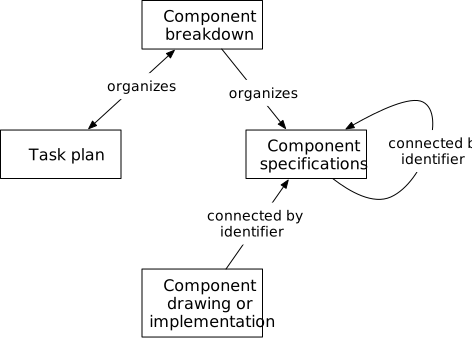
There are several kinds of relationships that people record. Some of these are:
- A lower-level component has a function that a higher-level component will use
- One requirement within a component implies other requirements on that same component
- A component passes on a general requirement to its subcomponents
- Two peer components will be interacting, and depend on each other’s functions
Let’s look at each of these kinds of derivation.
37.6.1 Subcomponents providing features for parent
A parent component has a requirement that the component provide some feature. The requirement in the parent specifies what the parent must do, but does not specify how to implement that feature. The design of the parent component, and later, the implementation, document how the parent component will satisfy that requirement.
When the designer decides on the implementation, they will decide (among other things) how the parent component will use subcomponents to implement the feature. These decisions create requirements on the subcomponents so that they provide the features that the parent component will use.
The reason for these requirements on subcomponents is that they are necessary to satisfy the requirement on the parent component. A derivation relationship between the parent requirement and the subcomponent requirements documents why the subcomponents have the requirements they do.
Consider a spacecraft example. The spacecraft as a whole has a requirement that it be able to point at a ground location, with some number of degrees of accuracy. To implement that feature, the spacecraft designer chooses to use the spacecraft’s attitude control system to point the spacecraft toward a ground location, and then slowly rotate the spacecraft as it passes over the ground location. The parent component—the spacecraft—has the high-level requirements for what it needs to do. The subcomponent—the attitude control system—must be able to slew accurately to an initial pointing vector, and then be able to slew slowly and accurately until the spacecraft is done with an observation. The slewing accuracy and speed are the derived requirements on the attitude control system.
The process continues recursively. The attitude control system designer decides to use reaction wheels as the primary attitude control mechanism. The requirements for slewing accuracy and speed create requirements on the reaction wheels for how quickly or slowly they can turn the spacecraft.
37.6.2 Internal derivation
Some components will have a requirement that specifies a very high-level capability the component must provide. For example, in a section on disposing of a component that is being discarded:
The component shall have a procedure for disposal that ensures that no confidential information is leaked to unauthorized parties
There are several ways this requirement could be met: destroying the retired component in house, crashing the component into the atmosphere or ground in a way that will assure the component is destroyed, or erasing the data on the component before giving the component to an outside entity for recycling.
Whatever the implementation decision is, it creates more requirements on the component, and those requirements derive from the decision on how to satisfy the requirement on protecting confidential information. If, for example, the implementation decision is to recycle a retired part, then this might lead to requirements like:
The component shall provide an interface by which an authorized user can command the erasure of all data stored in the component
The component shall provide a function that erases all data stored in the component
In some organizations, the practice is only to record derivation from one component to another. Sometimes that works out; in the example, the requirement for an erasure command could be on a command handling subcomponent, and the erasure requirement could be on a memory component. However, some components do not break down into subcomponents easily—for example, when the component is being implemented by an outside vendor. In other cases, it is simply clearer to document the implementation requirements for the component directly and then passing the requirements through to subcomponents, so that a user can see the totality of the functional interface to the component in one place rather than having to search through subcomponents for something they don’t know exists.
37.6.3 Pass through
External objectives and standards often impose general requirements on “all components of type X”, or the like. For example, an automobile might have a requirement that all electronic components function nominally across a temperature range of -40º C to +125º C. (See the section on Sets as subjects below for more on this.)
This requirement can be placed on the automobile as a whole; the requirement might read
All electronic components in the automobile shall function nominally across the temperature range of -40º C to +125º C
If the automobile includes engine, braking system, and entertainment systems as parts, the temperature range requirement can be passed down to those subcomponents:
All electronic components in the engine system shall function nominally across the temperature range of -40º C to +125º C
All electronic components in the braking system shall function nominally across the temperature range of -40º C to +125º C
The braking system controller unit shall function nominally across the temperature range of -40º C to +125º C
But the entertainment system, which is not safety critical and operates in the more benign environment of the passenger cabin, might have the requirement:
All electronic components in the entertainment system shall function nominally across the temperature range of -10º C to +50 C
In these examples, the general requirement is copied down into lower-level subcomponents until it reaches some component (such as the braking controller in the example) that does not have further subcomponents. Sometimes the requirement is copied verbatim, just changing the scope of the subject; other times, some component will have a variant on the general requirement.
This kind of derivation is sometimes referred to as allocating requirements to subcomponents.
37.6.4 Mutual dependency
Sometimes two components are peers of each other, and need to interact. A fuel tank provides fuel to an engine; a spacecraft communicates with a ground station to send telemetry and receive commands; client and server applications send messages to each other.
These interactions involve requirements on each of the components involved, showing how the components support each other. The fuel tank must send fuel; the engine must consume fuel. The spacecraft must be able to communicate with the ground station; the ground station must be able to communicate with the spacecraft.
This leads to pairs of requirements that record this mutual dependency. At a high level,
The spacecraft must be able to communicate with ground stations using protocol standard X
and
Ground stations must be able to communicate with the spacecraft using protocol standard X
These two requirements should show a two-way relationship with each other. (Formally, this introduces a cycle in the derivation graph.)
37.6.5 Using derivation
Derivation shows how requirements are related to each other.
Systems engineers use the record of these relationships for several tasks.
- Determining whether a design of the system can satisfy its top-level objectives, and encoding how a system’s design satisfies those top-level objectives.
- Determining whether a particular requirement is actually needed (and why).
- Tracking down the effects of making a change in one piece of a system on the rest of the system.
A derivation relationship between requirements on two different components helps to document the implementation approach for meeting a higher-level requirement. When a designer looks at the high-level requirement, they can see what features are used to implement the high-level requirement. The lower level requirements and their rationale allow the designer to see the argument that the implementation will be sufficient to meet the high-level requirement. This makes the design rationale available to people who didn’t create the design in the first place, but need to understand it to evaluate it or to make changes.
The section on analyzing requirements, below, goes into more detail on how one can look at the requirement derivation relationships to evaluate completeness or sufficiency, to argue whether low-level features are actually necessary, and to trace out the effects of making a change in requirements.
37.6.6 Viewing derivation
There are two ways that a user should be able to see derivation relationships. First, when looking at any one requirement, the user should be able to see what requirements this one is derived from directly, and what requirements derive directly from this one.
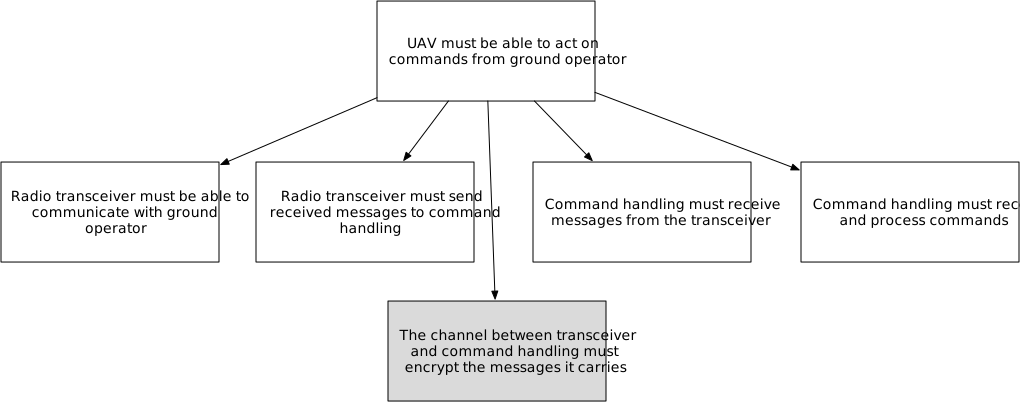
Good requirement management tools will also provide a view of the graph that shows derivation graphically. Derivation relationships can be viewed as a graph, as a way to see multiple levels of derivation. The graph is typically mostly a tree or DAG, but there are legitimate reasons that the graph will sometimes have cycles (between peer components, for example).
Here is an example showing how a top-level requirement is the source for a number of other requirements.
37.7 Advanced requirements
All the requirements discussed so far are simple requirements. Simple requirements have a single, clearly specified subject component. Each simple requirement expresses one property about that subject that must be true.
Simple requirements are not sufficient to express every need that real systems encounter. There are two that we have seen many times: requirements on sets of components, and requirements for standards.
37.7.1 Sets as subjects
Consider a system where all code is expected to adhere to a published coding standard. The implied requirement does not apply to any single component; it applies to all of them that include software.
This expectation can be written as a top-level requirement on the system as a whole:
All subcomponents of <the system> that include software shall adhere to the XYZ Coding Standard.
The subject of this requirement is the set of all software components in the system. The property is that their implementation adheres to the named coding standard.
This kind of requirement is placed on the top-level system, and then each first-level subcomponent includes a derived requirement that propagates the requirement downward:
All subcomponents of component X that include software shall adhere to the XYZ Coding Standard.
On a component Y that has software as part of its implementation then has:
The software in component Y shall adhere to the XYZ Coding Standard.
If component Y has subcomponents, Y should also have a second requirement that continues to pass the requirement down to Y’s subcomponents.
This is an example of a general technique:
- At some component, levy a requirement that is expected to apply to some subset of the subcomponents of that component
- Pass the requirement down from component to subcomponent by giving the subcomponent a derived requirement that is nearly a copy of the original, except for limiting the set of components
- When the derivation reaches a component to which the need applies, write a simplified requirement that names only that one component as its subject
37.7.2 Writing for standards
Many texts on requirements approach the subject from an assumption that there is one system being built: these are the requirements for System X. System X will be built in its entirety as specified; any and all requirements must be satisfied.
Writing standards is a different problem. A standard is specifying requirements on multiple hypothetical systems that may exist at some point. Those systems will not be identical, but the systems that adhere to the standards must adhere to the requirements in the standard.
Standards often provide options. The standard has a set of optional features. If the system chooses to implement those features, the features must conform to the standard. However, the system does not have to implement those features. This means that the system does not have to satisfy every requirement in the standard.
Some standards also present best practices. For some feature, it is recommended that the feature conforms to a part of the standard, but it is not absolutely required to do so.
The vocabulary of “shall” or “must” does not accommodate these situations well. The Internet Engineering Task Force (IETF) has defined a richer set of requirement modes. For example:
MAY. This word, or the adjective “OPTIONAL”, means that an item is truly optional. One vendor may choose to include the item because a particular marketplace requires it or because the vendor feels that it enhances the product while another vendor may omit the same item. An implementation which does not include a particular option MUST be prepared to interoperate with another implementation which does include the option, though perhaps with reduced functionality. In the same vein an implementation which does include a particular option MUST be prepared to interoperate with another implementation which does not include the option (except, of course, for the feature the option provides.) [BCP14]
The words used to indicate these more complex conditions must be defined just as carefully as “must” or “shall”, and must be used consistently.
37.8 Analyzing requirements
Many people think of requirements only as a contract for guiding implementation and a checklist for performing verification tests later. However, requirements—along with other specifications—are useful in themselves for helping build a design and making sure the design is good.
There are three kinds of analysis that systems engineers do on the requirements themselves:
- Ensuring that the requirements (and specification) are complete
- Ensuring that the design is minimal, meaning that the design only contains features that it actually needs and nothing extraneous
- Ensuring that the requirements are consistent
- Understanding the effects of making a change to one part of a system design
These are all analyses that should be done on the specifications of a system, including the requirements, and not delayed until implementation. Some of these tasks are easier to perform on the abstracted and simplified view of the system that specifications give. Performing these tasks before implementation will reduce the amount of re-implementation needed when one finds that the requirements aren’t sufficient or minimal.
37.8.1 Complete design
The expectation is that if a system is built to conform to its specification, including requirements, that the system will do the job that its users need and do it correctly. (Of course, this assumes that the top-level specifications are themselves a correct and complete record of the users’ objectives; we discuss this more in the section on validating requirements below.)
To meet this expectation, the system’s requirements need to be complete and correct. This means that when one looks at any given top-level requirement, one can trace out the features on other components that will be used to implement the requirement and argue that those features will combine correctly to produce the desired result.
There are two parts to this analysis:
- At each level of derivation, are the derived requirements complete for their parent? Is there a rationale that shows how these derived requirements are necessary and sufficient to implement the parent?
- Are the leaf requirements concrete, implementable, and verifiable?
Having tools that allow one to view parts of the derivation graph in visual, graphical form is invaluable to performing this analysis.
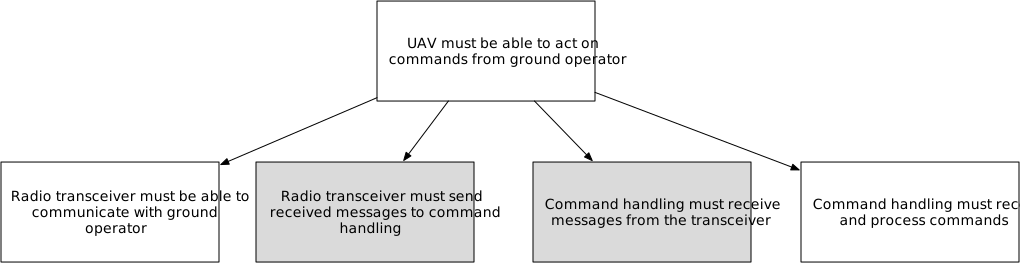
Consider an example. A UAV (drone) is supposed to receive and process commands from an operator on the ground. This leads to requirements:
These requirements are not complete, because they leave out a critical step: when a command is sent from the ground operator to the UAV, the message first goes to the transceiver. The receiver extracts the message, and then sends the message to the command and data handling component. The example omits the part about the transceiver and command handler passing information to each other. This means that one could build an aircraft that had a radio and had a flight computer, but the two would never talk to each other. Obviously, the UAV would not be acting on commands with that design.
This leads to a more complete set of requirements:
In the example, the communication between the transceiver and command handling components should be documented in some other specification for the UAV, perhaps an activity diagram showing how commands flow through components. The requirements then need to be checked against these other parts of the specification to make sure that all of the functions in each of the steps are reflected in the functions each component is required to implement.
Sometimes determining whether a set of requirements is complete or not will require further analyses. As a simple example, the maximum mass for an aircraft might be X kg. Making sure that the aircraft’s overall mass comes in under that limit means enumerating all the components in the aircraft that have mass, adding up their mass, and determining that the result is below X kg. For that analysis to be complete, it cannot leave out, say, the mass of the motors; all components must be considered.
As a more complex example, a system might have a maximum acceptable failure rate target. Being able to argue that the system is reliable enough involves performing a fault tree analysis, enumerating all the ways that failures in components can lead to system failures. The analysis cannot leave out components and be complete; nor can it leave out some failure modes of some of those components.
Checking whether the design is complete is not a simple task that can be performed just by inspecting the graph of requirements. The analysis is helped by being able to see the requirements, but it requires imagination and effort to actually check the result.
XXX Sidebar: relationship to Goal Structuring Notation and safety cases
37.8.2 Minimal design
Every feature and every requirement on a component should have a reason for being there.
At the top level, for the system as a whole, only features that address customer needs or business objectives should be included. At lower levels, the only requirements that should be placed on components should be ones that are actually needed to make the system work properly—meaning the system meets those top-level objectives.
37.8.2.1 Tracking the purpose for every requirement
The derivation relationships between requirements encode the reasons for a requirement to exist. This leads to a condition that should hold across all requirements:
Every requirement for a system and all its components should derive from one or more customer or business objectives
This is straightforward to check using the derivation graph: every requirement should derive from at least one parent requirement, and it should be possible to trace upward through the derivations to reach a customer or business objective.
Often while requirements are being developed, a requirement will be placed on some component without setting up the derivation. This requirement will not have a parent, and so the checking method will flag it. But what to do then?
In most cases, there was a good reason that someone wrote that component requirement. When one finds a requirement that is not documented as supporting some higher-level reason, it is worth exploring why that requirement is valuable. In some cases, the parent requirement(s) are present, and the requirement just needs to be linked to them. In other cases, the requirement can be a clue that there is some higher-level principle that the writer had in mind, and that higher-level principle should be added into the requirements higher up in the system.
For example, consider a data storage component where an engineer placed a requirement that all data be stored in an encrypted form. As written, that requirement doesn’t derive from any other requirement. But why did the engineer believe that encryption was necessary?
One answer is that encryption isn’t necessary. In that case the encryption requirement can be removed. Another answer is that the engineer wrote that requirement because they believed that the component would be storing confidential data that should be protected against disclosure. In that case, it is worth checking: does the system have requirements—or business objectives—about protecting confidential data? If not, then this exercise will have found a topic that has not been adequately addressed, and new requirements need to be added to make a correct specification. Those requirements should be added throughout the system, and the requirement we started with should show that it derives from those new features.
Many such requirements result from external standards that are supposed to be met, such as regulatory, safety, or security standards. Those standards should be included in the external objectives for the system, their requirements should flow down through the system to the components where the standards apply. This produces a record of how the system’s design complies with those standards.
37.8.2.2 Finding unnecessary requirements
Some requirements that show how they are derived from some parent requirement are still not actually necessary.
There is no simple, mechanical way to find these unnecessary requirements. However, the analysis used to determine whether a collection of requirements is complete is also useful for finding these unneeded requirements.
Consider this example:
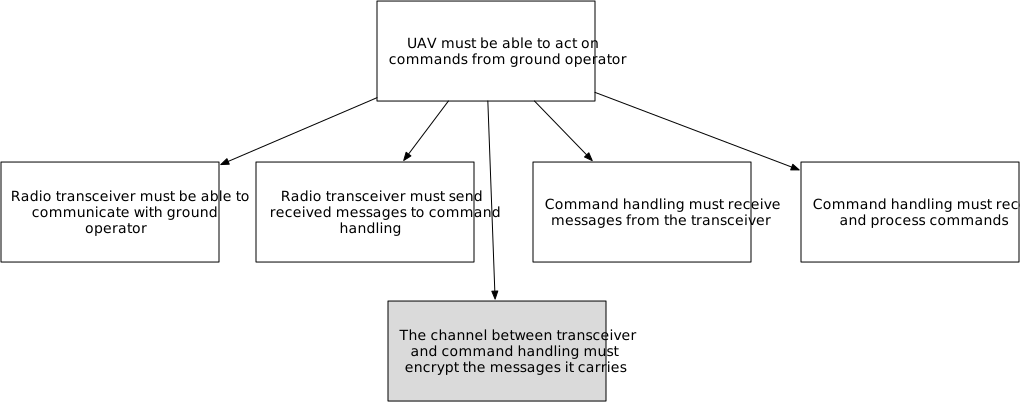
The requirement about encryption is not actually needed for the system in question. That is because the connection between the transceiver and command handling components is physically contained within the UAV, and the physical encapsulation provides enough security to protect the messages passing between the two. The encryption requirement can be removed with no loss of capability.
However, in this example, the engineer who wrote the encryption requirement had a good idea but expressed it wrongly. The engineer understood that the integrity of communication between the two components was important; a command that was properly received but garbled in being sent to the command handling component could be a problem. The presence of the encryption requirement should be replaced by a less costly requirement, that the channel must protect the messages it carries against corruption.
37.8.3 Consistency
Consistency in a body of requirements is when the requirements don’t contradict each other. If requirements do contradict each other, the system as specified isn’t implementable and the specification needs to be fixed.
Broadly speaking, there are three kinds of consistency that one should check:
- Consistency among requirements for one component
- Consistency between requirements on either side of an interface between two or more components
- Consistency between requirements on a higher-level component and the requirements on subcomponents that should show how the higher-level requirements will be implemented
As long as requirements are written as text, and not in a formal notation, consistency checking will be manual. It involves reading through each requirement, finding other requirements that address related topics, and checking that they are consistent with each other.
Some inconsistencies are fairly easy to detect. If one requirement says component X shall be blue and another says component X shall be red, it’s obvious—one must just read through all the requirements on component X and see that two requirements both deal with the color property and they say opposing things.
Other inconsistencies are harder to spot because they do not use the same language in the properties they are specifying. As an example, one requirement might say component X shall use encryption algorithm Y while another requirement says component X shall use protocol standard Z. If protocol standard Z allows encryption algorithm Y, this is fine. But if the standard does not allow that particular encryption algorithm (perhaps because the algorithm is outdated and no longer considered secure enough) then there is an inconsistency.
Another class of inconsistency comes from the states a component can take on. Elsewhere in the specification of a component, there should be a definition of the state machine that the component is supposed to follow. The requirements translate that state machine into individual actions that the component is expected to take in response to particular inputs. It is easy—especially when editing or updating the component’s specification—to have two requirements: when condition A occurs, component X must transition to state Y and when condition A occurs, component X must transition to state Z. The inconsistency can be more subtle, such as leaving out some transition, or using inconsistent definitions of the condition that causes the transition. This class of problem can be addressed by having a single, clear definition of the state machine the component is expected to follow, and then checking the requirements against the state machine.
Finally, another class of inconsistency that can be hard to detect has to do with timing. Two requirements can impose timing constraints that cannot both be satisfied. For example:
When event A happens on component X, event B must happen within 10 milliseconds
When event C happens on component X, event B must happen within 15 milliseconds
Component X must perform the events A, C, and B in that order
There is no way for component X to meet the timing requirements given the order that events must occur. Building a timing model of the component in question, and performing a timing feasibility analysis using that model, can help find this kind of inconsistency.
This is by no means an exhaustive list of the kinds of inconsistency one must look for.
37.8.4 Effects of changes
Systems change. This can happen because customer needs change, or because technology changes, or because someone has found a better design for part of the system. A good development process supports constant evolution and change of the design and implementation of a system.
Not every change that is proposed will be performed. When someone proposes a change, someone else will analyze the proposal to determine the effects of the change. Based on this analysis, people may decide to go ahead, postpone the change, or not make the change.
The analysis must accurately determine:
- What components are affected by the change? Is it just one component, or do effects ripple through much of the system?
- What things will need to change as a result? Component designs, specifications, safety analyses, regulatory filings?
- How extensive or expensive will those changes be?
This analysis makes use of all the specifications in the system, but requirements are a major contributor. In particular, the derivation relationships help show how component features depend on each other, and thus help guide an analysis of how far some change will spread.
37.8.4.1 Effects of top-level changes
Top-level changes include adding a new feature to the system, removing a desired feature, or changing a standard or other external source of requirements.
If the change changes a top-level requirement, look at the derived requirements from that changed requirement and see if the derived requirements are still necessary and sufficient to satisfy the newly-changed requirement. If they are, then no further action is needed. If they are not, then the derived requirements must be revised, possibly adding or removing some of them. The process then needs to repeat with these changed derived requirements. If the change affects a requirement that supports a different top-level requirement, then one must check that the other top-level requirement is still satisfied by the changed derived requirements.
If the change adds a new top-level requirement, work out what derived requirements are necessary and sufficient to satisfy the new requirement. Look for lower-level requirements that already exist that can also support the new requirement. This may involve a change in design, not just requirements; this will cause more changes to propagate out.
If the change removes a top-level requirement, see if any lower-level derived requirements are no longer needed or can be relaxed. If so, work downwards to propagate the effects of those changes.
37.8.4.2 Effects of lower-level changes
Many more changes will come to lower-level components in the system. There are many reasons this can happen: because people have found that a design in process is infeasible or too costly; because a vendor’s part specification or availability has changed; or because someone has found a better design for some lower-level component.
Evaluating a lower-level change involves all the checks for a top-level change above, along with the need to see how the change will affect higher-level requirements. Will the change leave the higher-level requirement unsatisfied? Will this change make some other sibling requirement redundant (that is, the parent is satisfied without the sibling)?
Tracking down these effects is much easier if the derivation relationships among requirements are accurate.
37.8.4.3 Tools
Good tools help the process of evaluating changes. There are three features in particular to look for:
- The ability to create an independent working version of the requirements, in order to try out changes before committing them to a baseline. The ability to see what has changed between the baseline and the working version and selectively merge changes into the baseline allow reviewers to understand the whole effects of the change and to accurately accept the changes.
- A feature to mark some requirements as potentially changing and others as needing evaluation. This feature helps ensure that the change evaluation does not miss some important change.
- The ability to record a rationale for a derivation relationship between requirements helps the people evaluating changes determine why a set of derived requirements was considered necessary and sufficient.
37.9 Validating requirements
XXX rewrite this to bring into line with introductory language on deriving verification
Validation is the process of determining whether a set of requirements accurately reflects the needs of the system. This can mean that the system will meet customer needs, or mission needs, or other external objectives.
It is important to keep validation separate from verification, which is discussed below. Validation is about seeing if the requirements (and the rest of the specification) is an accurate reflection of external needs. Verification is about seeing if the implementation is an accurate reflection of requirements. (Some software engineering texts focus validation on consistency, completeness, and similar properties. Systems engineering has generally kept those kinds of checks separate from validating customer or mission satisfaction.)
The validation process starts with checking the system objectives, business objectives, security and safety objectives, and regulatory objectives to see if they are an accurate reflection of the customer or mission needs. Presumably appropriate care has been taken while these objectives are being gathered and written down, but mission understandings or desires change over time and an independent check on the objectives will help avoid having problems be discovered late, when it is expensive to make changes.
At the top level, one should check:
- Is there anything in the top level that does not come from what the stakeholders want?
- Is there anything the stakeholders want that is missing?
- Are all the regulatory needs addressed?
At lower levels, one is checking whether the derived requirements from a parent are necessary and sufficient. The analyses for complete and minimal design, discussed above, cover those checks.
There are many different ways to validate a system’s specifications. They generally fall into two groups: analysis and simulation.
XXX improve language: analysis as formal method vs review as informal
Validation by analysis involves people reviewing the requirements and using their judgment to check the specifications. This can involve performing joint reviews with stakeholders so that they can check the requirements.
Validation by simulation involves stakeholders somehow seeing a model of the system in action. There are many ways to do this. Stakeholders can be invited to define some scenarios that represent how they will use the system, and then try out those scenarios using a model of the system. Some ways we have done this include:
- A desk or whiteboard exercise, where one or more engineers act out the system’s behavior and some stakeholders talk through what they would want to happen.
- Building a simple simulation model of parts of the system and letting the stakeholders try out their scenarios with the simulation.
- Building prototypes of parts of the system and having the stakeholders try out the parts of their scenarios using the prototype. This can be combined with a desk exercise for parts of the system that aren’t prototyped.
These validation exercises should be completed and the stakeholders should concur that the specifications are correct before one baselines the specifications, including requirements.
37.9.1 Connecting requirements and implementation artifacts
People must be able to navigate from a requirement to its associated implementation artifacts and vice versa. The people implementing a part of a system according to requirements need to be able to quickly and accurately find the requirements that they need to comply with. In the other direction, the people verifying requirements must be able to find the artifact or artifacts that implement a particular requirement.
The approach to organizing systems artifacts that I advocate here, which organizes many systems work around a hierarchical component breakdown structure, is designed to meet this need conveniently. The set of requirements that apply to some component are implicitly connected to other specifications and the implementation of that component because they are all organized by the same component names and identifiers.
One can also explicitly label artifacts with component identifiers or requirement ids. For example, verification test specifications are associated with specific requirements, so the test specification needs to be labeled with the requirement ids that it applies to.
37.10 Verification
Verification is the process of showing that the implementation of the system, or parts of it, complies with the requirements.
Verification involves gathering evidence that every requirement is satisfied by the implementation.
There are four general methods used to verify the implementation’s compliance:
- Inspection: review of the implementation (source code, board designs) to manually check that the implementation complies
- Test: define and perform tests on the implementation that check compliance. Many requirements require a number of tests in order to show that the implementation complies given all reasonable inputs or environment conditions
- Demonstration: show the implementation working as defined
- Analysis: perform a static analysis on the implementation to gather formal evidence that the implementation complies
Inspection is verification by having people review parts of the implementation to check that it complies with a requirement. The inspection review should be performed by people who did not implement that part of the system, so that the reviewers are not misguided by preconceptions (“I’m sure I implemented this correctly”).
Some inspections are particularly simple. Consider a high-level requirement that is the source for a few lower-level requirements. In many cases, the high-level requirement is satisfied when the lower-level derived requirements are all satisfied. In these cases inspection becomes a simple matter of checking that the derived requirements are all satisfied. The rationale associated with the derivation or with the high-level requirement should indicate when this situation applies.
Test and demonstration are similar. Testing is generally more exhaustive, and necessary lower-level components. A single electronic component, for example, might be operated across all the specified thermal, vibration, and atmospheric environments it must handle. Demonstration is less exhaustive, and used to verify top-level system objectives. A prototype spacecraft radio transceiver might demonstrate that it can communicate with ground stations from a similar orbit to where the final spacecraft system will operate.
Some requirements cannot effectively be verified by test or demonstration, and must be verified using analysis. This occurs when one is verifying a negative condition: the verification must show that the system will not perform some action or be in some condition at any time. Providing evidence of the absence of some condition is a long-standing scientific and engineering problem because proving the presence of some condition is relatively easy—demonstrate it happens in one case and that’s sufficient—but showing absence often requires exhaustive search. These verification problems often arise in safety and security requirements, where unsafe failures must be rare (e.g. no more than once in 109 operating hours) or a system must resist a class of attacks (showing that no attack of that class will succeed).
Each requirement should have an associated verification specification. The specification should lay out what steps must be taken to determine whether the implementation is correct or not. A verification specification is often complex—many pages of documentation for a three-line requirement.
Verification status is a measure of how well the implementation matches the specification, including requirements. In practice this means how well a version of the implementation complies with a version of the specification, as both implementation and specification evolve over time. This means that, during design or implementation, there is no one single “verification status” that can be tracked: with each new update to the implementation, the verification status changes. Some practitioners and tools make the mistake of tracking verification status only in terms of requirements: which requirements have been satisfied by the implementation? This leads to project management errors when a change is made to the implementation that improves the implementation in one area but causes other parts of the system to go out of compliance—a common occurrence while in the middle of implementation using iterative approaches.
37.11 Limitations of requirements
Requirements have limitations. Writing a good specification for a system means understanding these limitations and addressing them in one way or another.
One limitation is that requirements are written in natural language. Human language is notoriously difficult for pinning down precise meanings, even within a single group of people. Specifications, including requirements, are used to communicate between different groups of people with different outlooks, experiences, and jargon. This makes it hard to write requirements that will be interpreted the same way by all of the people involved.
The limitation of natural language can be partly mitigated using a couple of techniques. One is to maintain a glossary that defines words or phrases that have specific meanings in the specification beyond common understanding. The second is through social cohesion: having enough people from different groups interacting and discussing the system so that they evolve a common understanding of the meanings of things.
Precision is another limitation. Some specifications can be clear and simple in mathematical notation, while they are hard to follow in prose. (Consider expressing Newton’s law of gravitation as an equation versus in prose.)
A third limitation comes from requirements being single statements. Sometimes the specification needs to encode a complex, multistep activity. Each of the steps might be encoded as an individual requirement, but it is awkward and hard to understand. Sometimes the better answer is to write part of the specification in a different form—a flowchart, a state machine, or a set of equations.
As a result, requirements are only one part of the total specification. They cannot do the entire job of recording the full specification of the artifact in question—but they are often the most flexible way to organize most of the specifications. Be prepared to supplement textual requirements with other kinds of specification to get the whole job done.
37.12 Working with requirements
This chapter has mostly covered what requirements are. This section touches on what one does with them and how they evolve over time.
Requirements will change continuously over the life of a project. The rate of change will be high at the project’s beginning, when the team is trying to sort out what the system should be. The rate of change will increase after the high-level system purpose is sorted out and as the design work proceeds in parallel on different components in the system. The rate will taper off as the design and implementation become more mature, with occasional bumps as people find problems with the specifications, or as stakeholders request changes. Ideally the rate will reach zero when the system is ready to go operational, but even while in use people will find changes they would like to make.
Detailed requirements are expensive to develop and maintain. They encapsulate the complexity of how all the parts of a system are interconnected. They require effort to develop in the first place, involving checking for consistency and feasibility across large parts of the system. Changes later involve even more effort, especially if the changes involve reorganizing specifications that have already been developed.
This leads to a tension: changes will always happen, especially with modern, flexible systems, but the cost incentivizes developing all the requirements at once and then freezing them to minimize the cost of change.
This tension is unavoidable, but there are things one can do to reduce the difficulty.
- Don’t start finalizing requirements too early. Work with a sketch version of the main points while exploring the concept.
- Develop detailed requirements for a part of the system hand in hand with prototyping the components that make up that part of the system. Most teams learn a lot from prototyping exercises; what they learn translates into design changes and in turn into requirements.
- Start the processes for communicating about specification changes early in a team’s development, so that people have developed the habit of talking to each other about changes that might affect others before major, disruptive changes come along.
- Use the right tools that help the team coordinate developing and changing the requirements.
37.12.1 Supporting the life cycle
The requirements for a system—and indeed all the specifications for the system—grow and evolve over time. The times and ways when requirements change depends on the development process a project is using. However, all these processes share some tasks in common.
Collaborative development. In some phases of developing the specifications and requirements for a system, there will be many unknowns and the possible specifications will be in constant flux. In periods like this, many people will be involved in writing down possible requirements, often collaboratively. In phases like this, what matters to people is the ability to quickly sketch out some requirements, and the ability to share and collaborate on these sketches.
Incremental change. At other times, when the requirements and specifications are more stable, there will be incremental changes to the requirements. When someone makes a request for a change to the system, a systems person will need to evaluate the effects of that change. The ability to trace out the implications of a change using derivation relationships helps make the analysis process accurate. As the systems person works out the effects of the change, they need to be able to create an independent working version of the requirements where their updates will not affect an official, baselined version of all the specifications.
Baseline. While the requirements and specifications will be in some degree of flux all the time, the people who use those requirements need stability. The most common approach is to designate a version of the requirements as the current stable version, and then control updates to that stable version. The stable version goes by different names in different fields: baseline, release, plan of record, committed version. For the purposes of this document, we use the term baseline.
A project should use a configuration management or version management process to maintain the baseline requirements. There are many tools that automate such processes. The key features needed are that
- A user must always see the current baseline
- A user must be able to know when the baseline has been changed, and see how that change affects them
- No change is made to the baseline without review and approval
- Working versions of specifications that have not yet been approved do not appear in the baseline
Review and approval. People will propose updates to the system’s design as a project moves forward. This occurs often at the beginning of a project, as the design goes from vague ideas to concrete specifications; it continues during the life of the project as stakeholders ask for changes, as engineers find problems or improvements with the current design; and it can continue after a system is released to operation, as people find problems in actual use. These changes will result in specific proposed updates to the requirements. The proposed updates need to be checked before they are accepted and applied to the baseline. Once applied to the baseline, everyone developing the system implementation will need to work to revise their part of the implementation to match, and verification steps will be required, and so on—thus it is important to control changes to the baseline to be sure that they are sound and within the project’s scope before committing to them.
Projects generally use a review and approval process to decide whether to apply an update to the baseline or not. In the review part, systems engineers check the updates to ensure they meet guidelines, including consistency, completeness, and minimality. People who will be affected by the update are asked to review the update, to evaluate whether it is technically correct from their point of view and whether the change is feasible. Project managers are asked to evaluate the update to determine whether the change is in scope and whether there are resources to accommodate the change. If all those parties agree, then the update is approved and someone creates a new requirements baseline that incorporates the changes.
Verification. The implementation of the system needs to be verified from time to time to ensure that what is being constructed complies with specifications. Verification can happen at many different times and with different scopes. As someone implements a feature into a component, verification tests can provide immediate feedback to the implementer. In software development, this is related to test-driven development. Regular verification activities can detect whether a change in the implementation in one place has had an unexpected consequence that causes something else to go out of compliance. This is sometimes called continuous integration testing. When a vendor supplies a prototype component, the prototype needs to be verified for acceptance testing. And when the system is believed to be complete, final verification checks are required before the system enters into operation.
37.12.2 Who works with requirements
Many people generate or use requirements during the lifetime of a project. These include:
- The product or mission managers who define the system’s objectives and review and approve the top-level system requirements
- The engineers who develop, revise, and maintain the requirements
- Change management people who oversee the process to baseline and release consistent, committed-to versions of specifications
- Designers and implementers who build components following the specifications
- Engineers who design how different requirements will be verified
- People who verify implementations against the requirements
- Managers who track the progress of implementing requirements and the progress of verifying components
- Vendor managers who oversee the process of writing requests for proposals, evaluate vendor offerings, and oversee the acceptance verification of artifacts from vendors
- Vendors who design and build components according to requirements
- Contract specialists who incorporate requirements into vendor contracts
- Technical writers who develop operational and training manuals based on the requirements
- System operators who use the requirements to understand how the system works in operation
37.13 Tools
The right tools make working with requirements much easier and more accurate. However, different requirements management tools are designed to support different styles of requirement writing and use, so you need to choose tools that match how you will write, organize, and use requirements.
Here are some questions that can help you evaluate requirements management tools.
- Do the tools support the writing style and requirements organization strategy you use?
- If your project is using hierarchically-organized requirements, does the tool support that?
- Do the tools provide a way to organize requirements for one component into sections?
- Do the tools support organizing requirements in the way your project organizes them? If you organize requirements by component, do the tools support that?
- Do the tools provide ways to trace top-level requirements from external sources, like policies or standards documents, that are the source for those requirements?
- Do the tools support tracing the derivation relationships among requirements?
- Do the tools allow derivation among requirements within one component?
- Do the tools allow mutual relationships between two components, when those two components have mutual dependency?
- Do the tools provide ways to visualize the graph of derivation relationships?
- Do the tools allow one to record a rationale for derivation relationships, in addition to rationales for individual requirements?
- Do the tools support the relationship between requirements and implementation artifacts or other documents?
- Do the tools provide a stable identifier for requirements?
- Do the tools support reviews and baselining, or other versioning control mechanisms?
- Do the tools support the ability to create a non-baselined, work-in-progress version of some requirements?
- Do the tools provide a way to see the differences between a baselined version of requirements and a work-in-progress version?
- Do the tools enforce a review and approval process?
- Do the tools help notify those who are affected by a change and who thus should provide a review?
- Do the requirements tools integrate with other tools that support verification?
- If the requirements change, do the tools make it clear what requirements must be verified anew?
- If the implementation evolves, do the tools allow for verification results to be associated with a version of the implementation and not just with the requirements?
People will use the requirements management tools to perform a number of tasks. You should evaluate how well requirements tools support these activities.
- Writing new requirements: being able to quickly sketch out a set of requirements for some new component or some new function, and then fill in the details to complete a first draft of the new requirements. Ease of writing and editing is a key complaint about many requirements management tools.
- Reviewing and updating requirements: when someone requests a change to the system design or objectives, being able to find what things need to change and then being able to revise the requirements conveniently.
- Managing review, approval, and baselines: at some milestones, reviewers will need to see what requirements they should review, support them in the process of discussing the requirements, and tracking issues that are found until they are resolved. With some milestones, a version of the requirements will need to be approved (or not) and baselined.
- Performing requirements analysis: people will need to perform the analyses listed in the Analyzing requirements section, including checking that the design is complete, minimal, and consistent.
- Validation: people will need to review the requirements against the original mission or project objectives to see if the system will meet stakeholder needs. The reviewers are generally going to be independent reviewers who have not been using the requirements tools along the way. The tools need to support the reviewers determining whether the requirements are satisfactory, and tracking issues that are found.
- Verification: some people will need to develop tests or analyses to perform verification. Other people will then need to perform verification on system implementation artifacts, and track the status of how well the implementation is complying with requirements.