Related ideas
- Agile and spiral development methodologies
- Both advocate working in increments, with defined goals for increments and re-planning before starting the next increment
- Agile can lead to a random walk if not guided
- Spiral can lead to a falsely detailed long-term plan
- Estimation
- False precision leads to problems
- Meaning of commitment to plan
- OKRs
- Provide longer-term aspirational goals as well as concrete results that should lead to those goals
- Can provide guidance in developing a plan
- Often lead to out-of-date objectives and results that people stop taking seriously
Key ideas:
- Create a plan that has multiple horizons
- Iteration/sprint/week
- Quarter
- Year
- Long-term
- Plan current iteration/quarter/year plus drafts of the next one to three periods
- Current iteration is a solid commitment
- Drafts of upcoming periods are less certain
- Define objectives (and possibly key results) at each horizon
- Re-evaluate the plan each time one gets to a particular horizon
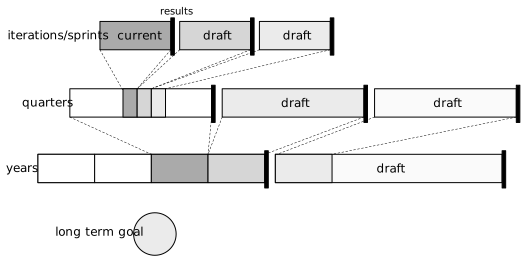
- Details for each iteration or sprint; more general for longer horizons
- Commit to the current iteration/quarter/year, draft plans out beyond
- Long term provides the general direction
67.1 Updating the plan
At the end of each iteration/sprint:
- Review how the iteration went
- Update the draft for the next iteration
- Add one more draft iteration
- Commit to the next iteration
At the end of a quarter or year:
- Similar process; maintain 1-3 draft periods
67.2 As the long term changes
When the long term goal changes, or when the plan needs to be rearranged:
- Change the longest term affected
- Work backward to see how to achieve that
- Change the quarterly drafts or current quarter
- Change the iteration drafts or current iteration
There’s no magic in this… just adjust the plan
67.3 Meeting the objectives
Keep moving toward a goal:
- There are long- and shorter-term goals to help make good choices about the plan for each iteration/sprint
- Having draft iterations and quarters promotes longer-term decisions, not just short-term reactivity
Flexibility:
- The drafts are still just drafts and can be changed as needed
- Draft iterations and quarters reflect uncertainty that changes over time
The plan is still a plan
- It expresses schedule and tasking information just as any other kind of plan
- Supports normal schedule analyses (e.g. critical paths, resource loading)
- It expresses task assignments for people
- Staff have a longer-term view than with pure agile, but a more realistic understanding of uncertainty than a detailed long-term schedule