The previous chapters have introduced the ideas of life cycle patterns and development methodologies, along with the ways that the two affect each other. Chapter 22 introduced a number of characteristics that one can choose to match a project. Chapter 24 presented a number of example life cycle patterns, along with a rough framework for comparing the examples.
In this chapter, I present a reference model of development methodology and life cycle patterns. This approach is based on the approaches I have used myself or have observed others using in successful projects, along with learning from projects that have gone poorly. These recommendations do not attempt to follow any of the development methodologies dogmatically, instead taking the parts from several of them that work well. In other words, I have tried to distill a pragmatic set of solutions from the many options available.
The reference life cycle covers the entire life of a systems-building project. It has four high-level phases: preparation, development, operation, and ending.
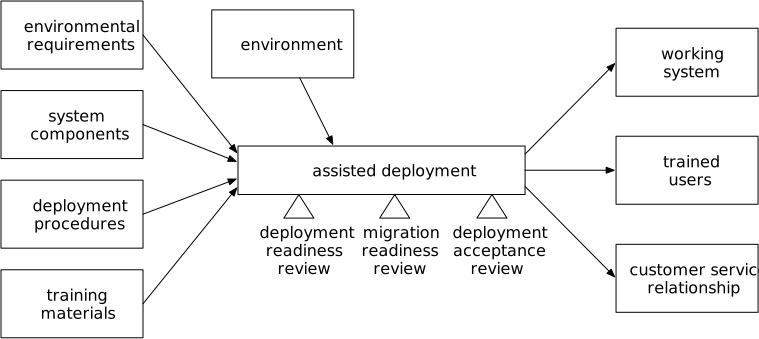
Project preparation is about setting up the project: how it will work, who is sponsoring it, who is funding it. Development covers working out what the system is for and then designing and building it, until it is ready for use. Operation is about producing the system, deploying it, using it, and evolving it. Ending is about shutting down the project when its work is done.
This reference also includes a project support “phase”, which includes all the activities that go on throughout the project to support operations.
Some projects are only concerned with building a system; once the system has been implemented and tested, it goes into production or operation and is no longer the concern of the development team. Those projects skip the operations phase. Most projects, on the other hand, have some level of involvement after the system is deployed and in operation, such as fixing bugs or enhancing the system. These projects involve all the phases.
The phases in the top-level life cycle in turn expand into more detailed patterns. Development consists of working out a purpose and a concept for the system, then developing a system to match, ending with a review to determine that the system is acceptable for putting into operation. Operation expands into a pattern of several phases, which I will discuss below.
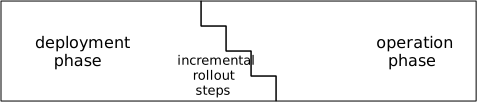
Some projects will spend most of their time in development, while others spend most of their time in evolution after the system is in operation. Exploratory spacecraft missions usually consist mostly of development, since once the spacecraft is launched there is little opportunity to change the spacecraft beyond the occasional software update. Mass-market consumer software, on the other hand, often spends as little time as possible on initial development and can spend years developing upgraded versions to keep consumers satisfied. This reference life cycle fits both kinds of projects.
The arrows in this diagram show how information and artifacts flow from one phase to another, but they do not necessarily indicate complete temporal orderings. For example, the project preparation phase often lasts quite a while, and overlaps early parts of the development phase. Within operation, different customers might deploy and operate their own instances of the system, and the project may be working on multiple system improvements at once.
Two of these phases—system development and system evolution—involve designing and implementing parts of the system. These are the two phases where a development methodology applies.
I will discuss each of the top-level project phases in turn in the coming chapters.
25.1 Projects with proposals
Some projects require developing a proposal to get funding or approval to proceed.
The life cycle for this kind of project adds a phase between preparation and development to develop a proposal. Developing the proposal typically involves developing the purpose and a preliminary concept for the system, so that the potential customer or funder can understand what they will getting if they agree to fund developing the system. The initial concept is then documented as part of the proposal itself, which is typically a document (often a large document) explaining what the system will be, how it responds to the customer’s requirements, how long it will take to develop, and how much it will cost.
Much has been written about how to do proposal development well. There is best practice for how to organize a proposal development team and what kinds of reviews are helpful.[1]
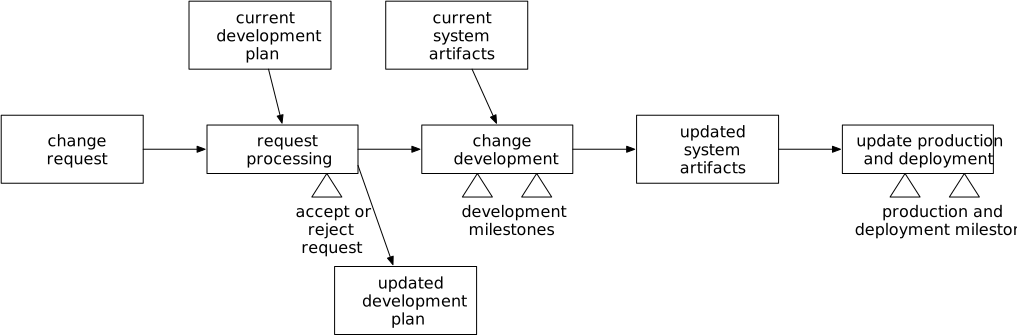
After the customer or funder has agreed to the proposal, system development proceeds as it does for other kinds of projects.
25.2 Project-wide decisions and reviews
Projects have times when there will be a decision whether to continue the project, end it, or continue with significant changes. Some examples: whether to start a project, when additional funding is needed to continue, or at periodic progress reviews.
These are often not driven by progress on making the system. They can be driven by external considerations, such as the need for funding, or by a regular cadence of progress checks.
Such reviews or decision points do not fit neatly into the flow of phases defined in the life cycle pattern. When multiple steps are in progress concurrently, as happens during most of the development phase, the decision often happens in the middle of several of them. Preliminary specification or design reviews are also common; they happen part way through specifying or designing part of the system. Design reviews often mean that design should have reached a given level of completeness for the top X layers of components in the system.
I will note some representative decision points in this reference lifecycle, but the actual milestones are project-specific.