6.1 Introduction
Working with systems is about working with the whole of a thing. It is a bit ironic that to make the whole accessible to rational design, we need to talk about the parts that make up systems work.
That is one of the first points about systems. Most systems are too complex for a human mind to remember and understand as a whole at one time. To work on these systems, people must find ways to abstract and to subset the problem. This book discusses some of the techniques for slicing a system into understandable parts, along with ways to use those techniques and why to use them. In the end, however, everything in here deals with carefully-chosen subsets of a system.
This chapter covers some of the essential concepts and building blocks that are the foundation for the techniques discussed in the rest of this book.
The subjects for systems work can be divided into five groups:
- The system’s purpose;
- The system’s boundary or scope;
- The parts and views of the system;
- The structure and emergence in the system; and
- Evidence that the system and its design meet its purpose.
The first four subjects are connected by a reductive approach to explaining complex systems, in which the high-level purpose is explained by reducing it to simpler constituent parts and structure, and conversely expressing the purpose as emergent from these simpler parts. The final subject is about ensuring that the system does what it is supposed to do (and only that).
6.2 System purpose
Every system that is designed and built has a purpose. That is, someone has an expectation of the benefits that will come from building the system, and they believe that those benefits will outweigh the costs (in resources, time, or opportunities) that will be incurred building the system.
Every system must be designed and built to address its purpose, and no other purposes, at the lowest cost practically achievable. This point may seem uncontroversial on its surface, but I have observed that the majority of projects fail to work to this standard, and incur unnecessary costs, schedule slips, or missed customer opportunities. Every design choice must be weighed according to how well each option helps satisfy the purpose or not; if an option does not, it should not be chosen.
Making design decisions guided by a system’s purpose means that the team must understand what that purpose is. The purpose must be recorded in a way that all the team members can learn about it. It also needs to be accurate: based on the best information available about what the system’s users need, and as complete as can be achieved at the time. The record of the purpose should avoid leaving important parts implicit, expecting that people will know that systems of a particular kind should (for example) meet certain safety or profitability objectives; people who specialize in one area will know some of these implicit needs but not others. The purpose documentation should also include secondary objectives, such as meeting regulatory requirements or leaving space in the design for anticipated market changes.
The understanding of a system’s purpose and costs will shift over time, both as the world changes and as people learn more accurately what the system’s value or cost will be. When the idea for the system Is first conceived, the purpose may be accurate for that time but the understanding of the cost is likely to be rough. As design and development progress, the understanding of cost improves, but the needs may change or a customer may realize they misunderstood some part of the value proposition.
A system’s purpose also changes over longer periods of time. People add new features to an existing product to expand the market segment to which it applies or to help it compete against similar products. The technology available for implementing a system changes, creating opportunities for a faster, cheaper, or otherwise better system.
Systems leadership have to balance the needs for a clear and complete statement of a system’s purpose with the fact that the understanding of purpose will change over time. The agile [Agile] and spiral [Spiral] management methodologies arose from this need for balance between opposing needs. Chapter 22 addresses how systems engineering methodologies can help address this need.
Working in a way that is driven by system purpose requires discipline in the team and its leadership. Many junior- and mid-level engineers are excited about their specialist discipline, and want to get to designing and building as quickly as possible—after all, those are the activities they find fulfilling. I have observed team after team proceed to start building parts of a system that they are sure will be the right thing, without spending the effort to determine whether those parts are actually the right ones. Those design decisions may end up being correct many times, which leads to a false confidence in decisions taken this way (“I’m experienced; I’m almost always right!”). The flaw is that the wrong decisions can have a high cost, high enough to outweigh any benefit from the rapid, unstudied decision.
I have heard many teams say—rightly—that they need to make some design decision quickly, see whether it works, and then adjust the design based on what they learn. This line of reasoning is both a good idea and dangerous. If a team actually does the later steps of evaluating, learning from, and changing the design then this approach can result in good system design. (This is discussed more in later Chapter 44 on prototyping and Chapter 65 on uncertainty.) However, most teams lack the leadership discipline to perform to this plan: once there is some design in place, pressures to keep moving forward drive teams to live with the bad initial design and accept complexity and errors. It requires discipline and commitment from the highest levels of an organization to take the time needed to learn from an early design and change what they are doing. The leadership must be prepared to push back against pressures to just live with a poor design and instead to require their team to take the time to learn and adjust, and to be clear with external parties, such as investors, that the plan is a necessary and positive way to realize a good product.
6.3 System boundary
A system has a boundary that defines what is within the system and what is not. What the system does (its functions) and what it uses to do them (its components) are within the system.
The rest of the world is outside the system. The outside world includes the system’s environment: the part of the world with which the system interacts.
The boundary defines the interface between the system and its environment.
What is inside the system and where the boundary lies are within the control of the project building the system. The project must adapt its work to everything else outside the system boundary.
6.4 System parts and views
Systems are designed and built by people. The methods used to build them must account for two human issues. First, most systems today are too complex for one person to keep in mind all the parts at one time, leading to a need to work with subsets of the system at any given time. Second, most systems also require multiple people to design or build, either because of specialties or the total amount of work involved. This leads to the need to break the work up into parts for different people to work on.
There are two techniques used to address this need. First, systems are divided into component parts, typically in a hierarchical relationship: the system is divided into subsystems, which are in turn subdivided, until they reach component parts that are simple enough not to require further subdivision. Second, people approach the system through narrow views, each of which covers one aspect of the system but across multiple component parts—such as an electrical power view, an aerodynamics view, or a data communications view.
Dividing the system into component parts creates pieces that are small enough to reason about or work on in themselves. The description of the part must include its interfaces to other parts, so that the design or implementation can account for how it must behave in relation to other parts. However, the interface definitions abstract away the details of other parts, so that the person can concentrate their attention on just the one part.
Dividing up the system also allows different people to work on different parts, as long as both parts honor the interfaces between them. The division into parts, and the definition of interfaces, create divisions of responsibility and scope for communication for the different people. This is addressed further in the Teams section (Section 7.3.3).
The hierarchical breakdown of the system into components and subcomponents provides a way to identify all of the parts that make up the system, ensuring that all can be enumerated. It also defines a boundary to the system: the system is made up of the named parts, and no others.
Reasoning about views of a system provides a similar and complementary way of managing the complexity of reasoning about a system by focusing on one aspect across multiple parts, and abstracting away the other aspects. This allows different people to address different aspects, as long as the aspects do not interact too much. For example, specialist knowledge, such as about electrical system design, can be brought to bear without the same person needing to understand the aerodynamics of the aircraft in which the electronics will operate.
6.5 Structure and emergence
Decomposing a system into component parts is one part of the system’s design; the other part is how those components relate to each other. The relations between parts define the structure of the system. These relations include all the ways that components can interact with each other, at different levels of abstraction. At low levels, this might be interatomic forces at the molecular level; at medium levels, mechanical, RF, force, or energy transfers; at higher levels, information exchange, redundancy, or control.
The structure needs to lead to the system’s desired aggregate properties, such as performance, safety, reliability, or specific system functions like moving along the desired path or providing reliable electrical service.
The aggregate properties are emergent, and arise from the way the structure combines the properties of individual components.[1] The structure must be designed so that the system has the desired emergent properties and avoids undesired ones. For example, a simple reliable system has a reliability property that arises from the combination of two or more components that can perform the same function, along with the interaction patterns of each component receiving the same inputs, each component generating consistent outputs, how the two or more results are combined, and how each component responds to failure.
The structure must be designed to avoid unanticipated emergent properties, especially when those properties are undesirable. In a safe or secure system, for example, it is necessary to show that the system cannot be pushed into some state where it will perform an unsafe action or provide access to someone unauthorized. Avoiding unanticipated emergent properties is one of the hardest parts of correctly designing a complex system.
The structure must be well-designed for the system to meet its purpose, and for people to be able to understand, build, and modify it. In particular the structure needs to be:
- Understandable by the people who design, implement, verify, and use the system;
- Analyzable and verifiable so the system’s design and implementation can be confirmed to meet the system’s purpose; and
- Modifiable as needs and technologies change.
There are good engineering practices that should be followed to achieve these aims, as I discuss in Chapters 43, 49, and 55.
Finally, the structure determines the interfaces that each component part must meet. Those interfaces in turn determine a component’s functions and capabilities, which guide the people working on the component, as discussed in the previous section.
6.6 Evidence
It is not enough to design and build the system; the team must also show that the system meets its purpose.
The team developing or maintaining the system must be able to show that the system complies with its purpose to customers, who need to know that the system will do what they expect; to investors, who need evidence that their investment is being used to create what they agreed to fund; and to regulators, especially for safety- or security-critical systems, who are charged with ensuring that systems function within the law.
The team also needs to ensure that pieces of the system meet the system’s purpose as they are developing or modifying those pieces. They must be able to judge alternative designs against how well they meet the purpose, and once built they must be able to check that the result conforms to purpose.
The process of showing that a system or a component part fulfills its purpose involves gathering evidence for and against that proposition, and combining the evidence in an argument to reach an overall conclusion about compliance. There are many kinds of evidence that can be gathered: results of testing, results of analyses, results of expert analysis, or results from performing a demonstration of the system. These individual elements of evidence are then combined to show the conclusion. The combination usually takes the form of an argument: a tree of logic propositions starting with the purpose and devolving hierarchically into many lower-level propositions that can be evaluated using evidence. The process must show that the structure of the argument is both correct and complete in order to justify the final conclusion.
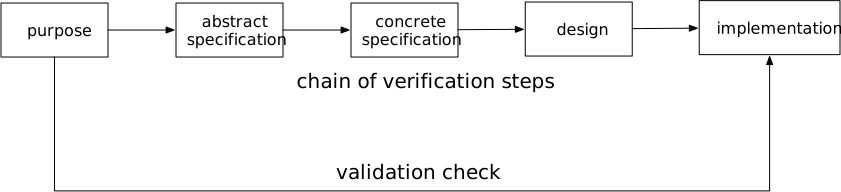
Pragmatically, arguments about meeting purpose usually follow a common pattern, as shown below. The primary argument that the implementation meets the purpose consists of a chain of verification steps. The implementation complies with a design, which complies with a specification, which complies with an abstract specification, which complies with the original purpose. As long as each step is correct, then the end result should meet the original purpose—but at each step there is the possibility of misinterpretation or missing properties, or that the verification evidence at each step is not as complete as believed. In practice this approach leaves plenty of uncaught errors in the final implementation. To catch some of these errors in the chain of verification steps, common practice is to perform an independent validation, in which the final implementation is checked directly against the original purpose.
Some industries, particularly dealing with safety-critical automotive and aerospace systems, add an additional kind of evidence-based correctness argument. This is often called the safety case or security case, and consists of an explicit set of propositions, starting with the top level proposition “the system is adequately safe” (or secure) and showing why that conclusion is justified using a large hierarchy of propositions. The lowest-level propositions in the hierarchy consist of concrete evidence; intermediate propositions combine them to show that more abstract safety or security properties hold. (See, for example, one group’s guidance on writing assurance cases [ACWG21].)
Finally, evidence takes many forms, depending on what needs to be shown. Some correctness propositions can be supported by testing. These typically show positive properties: the system does X when Y condition holds. Some of these conditions are hard to test, and are better shown by analysis or human review of design or implementation. Negative conditions are harder to show: the system never does action X or never enters state Y, or does so at some very low rate. These require analytic evidence, and cannot in general be shown by testing.
I discuss matters of correctness, verification, validation, and the related arguments in Chapter 14.
6.7 Using this model
The model in this chapter provides a way to think and talk about systems work. As a team begins a systems-building project, it will be gathering information or making decisions that can be organized using this model. The model can help guide people as they work through some part of the system. For example, the system’s purpose is reflected in the emergent behavior of the system, which in turn depends on the structure of how components interact. When the system is believed to be complete, the team should be able to verify that all of the relations indicated by this model are defined and correct. Later, as the system needs to evolve and the team makes changes to the system, this model helps them reason about what is affected by some change.
This model of systems provides a foundation for organizing the work that needs to be done to build the system. The next chapter presents a model for this work of building a system or component. The information about one component is represented in a set of artifacts, and there are tasks that make those artifacts. The structure of the artifacts, and thus of the tasks, is based on the model of systems and components in this chapter.
Part III goes into greater detail about each part of this model.