- 12.1 Introduction
- 12.2 Definition
- 12.2.1 Examples of functional relationships
- 12.2.2 Examples of non-functional relationships
- 12.3 Abstraction
- 12.3.1 Kinds of abstraction
- 12.3.2 Abstraction of objectives or component structure
- 12.3.3 Overlapping abstractions
- 12.3.4 Abstracting a relationship
- 12.3.5 Consistency
- 12.4 Emergent system properties
- 12.4.1 Examples of emergent properties
- 12.5 Working with structure
12.1 Introduction
Component parts of a system define the building blocks out of which a system can be built, but by themselves they do not create the complex, high-level behaviors that systems are built to exhibit. System behaviors and properties arise from how the component parts work together. How the components are connected, and how they interact over those connections, is the structure of the system.
In this chapter, I define what is meant by system structure and provide examples of how behavior can emerge from the combination of components and their interactions.
To build a system, one generally has to build a model of what the system is and does. This model will play essential roles in designing a system and analyzing its design. Enquiry into how to organize information about a system’s structure helps one develop a useful model, and so in this chapter I present an informal way to model a system’s structure.
12.2 Definition
The meaning of “system structure” has been debated, but I use the following definition, chosen for its engineering utility:
This structure can be expressed as the graph of how components affect each other.
Components can be related in two different ways:
- A functional relationship, which defines how an event in one component can cause an event in another component, and
- A non-functional relationship, which defines how events in two components are correlated (or not).
Functional relationship. The functional relationship is a relation from one component to another that maps how some output on an interface of one component can potentially be received on an interface of another component, and thereby cause a reaction in the receiving component. That is, the functional relation is a map of possible interactions that can be viewed as a directed graph, with components as nodes and directed edges showing how causation can flow between them.
Consider two electronic components connected by a signaling line, similar to those used in several serial communication standards. One component is able to send a signal on the line by changing the voltage relative to a common ground; the other component is able to observe the voltage and determine what signal was sent. By sending a sequence of different voltage levels, the sender can transmit a series of zero and one bits over the line to the receiver. The receiver can decode the bits into a message, perhaps containing a number, and act on the message it has received.
This functional relation is separate from and mostly independent of the component breakdown, defined in the previous chapter. The component breakdown is primarily about organizing the parts so they are identifiable, and do not imply a causal relationship. Functional relationships show how components in different parts of the component hierarchy work together. The component breakdown is helpful for defining levels of abstraction; I will deal with those in the next section.
Non-functional relationship. A non-functional relationship between two components indicates how their behaviors may be related in non-causal ways, such as two components being independent of each other or showing correlated behaviors. These effects do not depend on interaction between the components, but instead are based on inherent characteristics or history of each component.
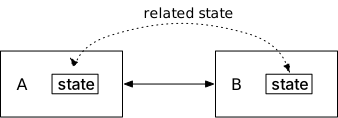
Independence and correlation are typical non-functional relationships. These terms are defined in the usual statistical sense. Informally, two components are independent if the probability of some event occurring on both components is the same as the product of the probability of each event occurring on its own. Events on two components exhibit some degree of dependence if the probability of both occurring is different from the product of each event occurring on its own. For a positive correlation, when one event occurs the other is more likely to occur. For a negative correlation, when one occurs the other is less likely to occur. At the extremes, one event occurring means the other is certain to occur, or that the two events never occur together.
Many non-functional relationships are the result of common-cause events. This can occur when two otherwise-independent components A and B have functional relationships with a third component C. When an event occurs in C, it interacts with both A and B so that both change their states. After such an event, the states of A and B are no longer independent.

System reliability is often built on a foundation of failure independence. For example, data can be stored in two copies, so that if one copy fails the other remains available. A scheme like this fails when both copies fail, and so the copies are designed to be independent to minimize the chances of both failing together. Independence can be a result of using different technologies to store each copy, or using devices from different manufacturers. Two devices from the same manufacturing batch might share a common manufacturing defect, which would increase the probability that both will fail.
12.2.1 Examples of functional relationships
Here is a list of some kinds of functional relationships that I have encountered in systems I have worked on. The first few relationships are simple and primitive from an engineering point of view, while the later examples are built as abstractions on top of simpler relationships.
- Mechanical force transmission. One component can apply force to another component, perhaps causing the second component to move.
- Electrical energy transmission. One component can provide electrical energy to another component, which allows the second component to turn a motor or operate electronic circuits. The first component thus has a degree of control over the second: when it provides energy, the second component can operate; when the first does not, the second component does not operate.
- Fluid movement. One component can send a fluid (perhaps a gas or liquid) to another. As with electrical energy, the receiving component can use that fluid to perform some actions, such as moving using hydraulic systems or transforming a fuel into kinetic energy in an engine.
- Data movement. One component can send information to another, perhaps using an electric or optical connection between them. The second component might store that information, changing its internal state, or it might perform some computation action on the information, such as computing a control action based on sensor data. Data movement is typically an abstraction on top of a lower-level electrical or optical relationship (though other relationships, including force transmission, are sometimes used).
- Control. One component can provide abstract control over another, providing actuation commands to the second component. The second component uses those commands to change its state or behavior. A control relationship is typically built as an abstraction on top of a data movement relationship.
- Authorization. In many systems, a person or component needs to have permission in order to perform some action; if it lacks that permission, it will be prevented from performing the action. Authorization is typically granted by one component to another component. For example, an administrator can use a permissions management tool to record who is allowed to do what; when a user attempts to request another component to perform some action, that component checks with the permission system to verify that the action is allowed. In this way the permissions management tool provides control over the component that is doing the checking. This is a highly-abstracted relationship between the permissions tool, user, and other component—but there remains a causal relationship among them.
12.2.2 Examples of non-functional relationships
Non-functional relationships capture ways that components can behave in coordinated ways without a direct causal relationship between them. These are typically states or behaviors that occur because two components share some common state (or do not share such state).
The following examples all relate to the independence or dependence of different components that are being used redundantly to improve reliability.
- Location independence. Essential IT systems are expected to survive disasters, such as a fire, storm, or earthquake destroying a building housing servers and storage. This leads to using two data centers located far apart geographically—so that they are unlikely to experience local disasters at the same time. This location independence relationship does not involve causality between the two data centers; it involves only their state of being in different locations in relation to expected kinds of disasters.
- Batch independence. Two separate but otherwise identical components might have been produced at the same time on the same factory line. This can lead to those two components sharing a common manufacturing defect: contamination in some material used in their manufacture that is not caught during acceptance testing, for example. Common manufacturing defects can lead to common failure modes, which is a problem if the two components are supposed to provide redundancy for each other. As a concrete example, an electronics board used in a spacecraft might have the wrong solder used to make connections, which can lead to the development of tin whiskers that create shorts on the board. If two or more components are being used for redundancy, selecting components from different batches that are unlikely to share manufacturing defects can reduce the chances that both will fail at the same time.
- Wear correlation. Mechanical components often experience some kind of wear as they are used. Rotating components such as a wheel, for example, have to interface to a non-rotating component. The interface between the two is designed to minimize friction using smooth finishes, lubricants, and bearings—but there will still be some small amount of friction that will wear down the surfaces over time, leading to increased friction. Eventually the friction will become great enough to interfere with correct operation. Installing multiple new mechanical components at the same time and using them in the same way leads to correlated probabilities of failure. Mixing components of different ages, or applying different usage patterns to them, can reduce this correlation and improve the effectiveness of redundant designs.
- Common-cause failure modes. This is a catch-all for many kinds of correlated failures, when two components that are nominally independent in fact respond to common situations by failing—perhaps in different ways. Consider primary and backup control systems, where the backup has a different implementation than the primary and provides a simpler control capability. (In spacecraft systems, this backup is sometimes called “safe mode control”.) In most situations, if one of the two components has a problem, it is unlikely that both will fail; this results in increased reliability over having just one or the other. However, there can be some situations that will cause both the primary and backup to fail: some input condition that neither can handle, such as a rotation rate beyond what the system designers expected to be possible, or an environmental condition, such as a radiation burst that damages the electronics of both the primary and the backup.
12.3 Abstraction
An abstraction is a summary or reduced form of a more complex thing, usually focused on the essential or intrinsic aspects of the complex thing. The abstraction is separate from any concrete instantiation of it.[1]
People use abstraction to manage the complexity of a large system. In an airplane, people talk about “the electrical system” or “the powerplant”—things that are built out of thousands of subcomponents, but which are usefully thought of as whole things in themselves. While the component breakdown structure, in the previous chapter , is one example of abstracting the details of multiple components into one larger, abstract component (or subsystem), most complex systems have multiple, overlapping ways to abstract and simplify views of the system.
12.3.1 Kinds of abstraction
Because abstraction is a powerful tool, it is used in multiple ways in understanding complex systems. Here are three of those ways.
First, abstraction is used to understand component structure. It shows how one complex, abstract component is made up of a number of subcomponents. The focus is on the hierarchical containment or decomposition of components. The high-level component has a single set of functions or properties it provides in the system, and the abstraction shows how this set is provided by functions or properties in subcomponents. Note that the high-level component need not have a unitary physical realization; instead, it may be realized in many physical subcomponents spread throughout the system’s physical space.
Second, abstraction is used to show how the objectives for a system or component are realized in lower levels. The focus is on how an objective (or purpose) is decomposed into objectives for lower-level parts of the system. It can be expressed as the tracing of a high-level objective to lower-level objectives. An abstracted objective need not be constrained to follow the system’s component hierarchy. High-level objectives might be decomposed into lower-level objectives within the same component. High-level objectives might also be decomposed into objectives for multiple different components, some of which are not close together in the component hierarchy.
Finally, abstraction is used to reason about the chain of how an abstract property or objective is mapped through layers of specification to a design or implementation that realizes that objective. This is similar to means-end hierarchies, which have been used to reason about how products are selected. Leveson uses a five-layer approach, starting with system purpose, mapping that to system design principles, then black box behavior, then physical and logical function, and finally physical realization [Leveson00, §4.2.1]. This use helps people reason about the specification and design process as well as about the structure of the system.
12.3.2 Abstraction of objectives or component structure
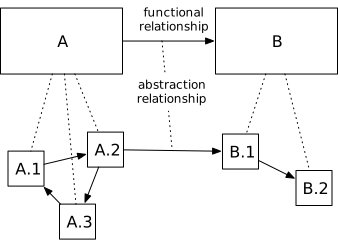
In general, abstracting structure is about taking a relation between two (or more) high-level components and breaking it down into relations between subcomponents. In the example below, two high-level components A and B have a functional relationship. A and B are both abstractions of a set of subcomponents. The relationship between A and B is an abstraction of the relationship between the A.2 and B.1 subcomponents.
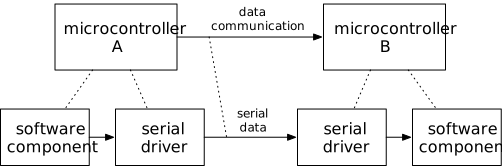
As a concrete example, consider software on two microcontrollers that communicate over a serial line. The software on each breaks down into an application software component and a serial driver. The serial drivers communicate (over a serial cable) directly.
Non-functional relationships can follow a similar pattern. If two high-level components A and B exhibit some kind of correlated behavior without direct causation, and those high-level components decompose into lower-level components, then at least one of the subcomponents of A must have a corresponding non-functional relationship with a subcomponent of B.
12.3.3 Overlapping abstractions
Abstraction is not necessarily purely hierarchical: some high-level abstractions overlap. Two different people can look at the same component and need to work with different aspects of it, and see it as part of different high-level abstractions. This is common in systems of even moderate complexity.
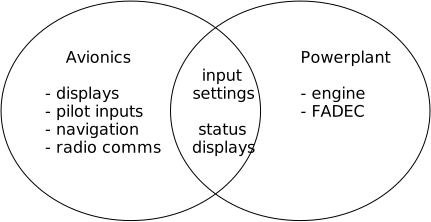
Consider an aircraft with modern avionics and engine systems. The avionics provide many functions: flight deck displays, pilot inputs, navigation, radio communications, autopilot, among many others. The powerplant provides thrust to move the aircraft and electrical power to run other systems, but in a modern aircraft it also includes an engine controller (FADEC) that provides autonomous management of engine operations.
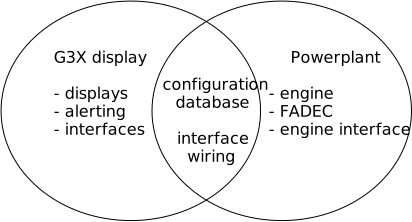
The avionics and powerplant have overlap. The flight deck display will display engine status: thrust, temperature, thrust reverser deployment, and alerts when there are engine problems. The pilot thrust levers are connected to avionics, but provide commands to the engine controller. The autopilot needs to know the capabilities of the engines and how to provide them with control settings.
This overlap leads to a question: is the engine display function part of avionics or part of the powerplant? The answer is that it is part of both, depending on who is looking at that part of the system.
Consider a specific avionics unit for general aviation aircraft: the Garmin G3X display [Garmin13]. It can connect to an engine interface adapter, which in turn connects to sensors or a digital engine controller on the engine. The display is a general-purpose component, which can provide a pilot with many different kinds of information; engine status is just one function. The G3X unit contains a configuration database that defines what engine information it will be receiving, how to display that information to the pilot, and the conditions when it should issue alerts. This database resides within the avionics display unit, implying that someone designing the avionics system will be concerned with it. However, the database is specific to the powerplant installed on the aircraft—changing an engine model requires changing the database—and so it is of concern to people designing the powerplant.

This pattern is common in systems that have multiple functions: some particular component will contribute to multiple high-level functions, and different people will see that component as part of one abstraction or another based on what functions they are working on. Models of the system must accommodate these overlaps.
When two abstractions overlap, shared components must support both abstractions by implementing behaviors and properties that accurately support both higher-level abstractions. In the G3X avionics example, the configuration database needs to address the configuration of the powerplant as well as the interface to support pilot information displays. This can add complexity to designing the shared component, since behavior that supports one abstraction must not interfere with behavior necessary to support the other.
12.3.4 Abstracting a relationship
Some relationships between high-level, abstract components are themselves abstractions.
Consider once again the example of two microcontrollers that communicate with each other, as in the earlier section, but this time they communicate using a wired Ethernet rather than a serial cable. At the abstract level, there is a functional relationship from A to B where A sends data to B.
The data communication relationship, however, is an abstraction. The microcontrollers communicate using an Ethernet, which might consist of a pair of cables and a switch. The cables and switch reify the abstract relationship, meaning they take the abstract and make it into something real.
The inputs to and outputs from the reified data communication link are the same (at the abstract level) as the high-level abstract relationship: data gets transferred from microcontroller A to B.
This is an example of a general pattern. Two components at a high level may have a functional relationship, and both the components and the relationship between them decompose into a number of subcomponents. The consistency between the high-level abstraction and the lower-level details must be maintained, of course, but there is nothing that requires that a high-level relationship can only decompose into lower-level relationships.
In fact this pattern continues recursively down to the lowest observable levels. In the example, microcontroller A passes data into the Ethernet cable as a set of low-level electrical signals. Those signals, in turn, are made up of yet lower-level electromagnetic behaviors of the atoms in the conductors that join the microcontroller to the cable.
12.3.5 Consistency
A high-level abstraction and a lower-level implementation of the abstraction need to be consistent with each other. Speaking broadly, the high- and low-levels are consistent with each other if the low level implements everything in the high level abstraction, and everything in the low level implementation is reflected in the abstraction—that is, that neither level adds or removes anything from the other.
Abstraction does imply simplification, however. The high-level abstraction of a distributed software component might have a “logging” relationship to a centralized monitoring system. The decomposition of that relationship might involve a logging subcomponent within the software that uses a network connection to send log records to a receiver component within the monitoring system. The high-level logging relationship focuses on the ability to reliably and securely send log information to the monitoring system. To be consistent, the lower-level details must provide a way to transfer that information—using the network to move the data, for example. The statement that the information is sent securely—which would need to be better defined at the high level—might be matched by state and behaviors of the endpoint software components to authenticate each other and encrypt data in transmission.
Continuing this example, the lower-level implementation would not be consistent with the high-level abstraction if the network communication mechanism provided a way to send information in the other direction, from the monitoring system to the distributed software component.
This can be put in somewhat more formal terms as follows.
- Components: Within one abstraction-implementation hierarchy, each high-level abstract component decomposes into one or more lower-level components. (Note that if a component is not decomposed, it isn’t abstract.) All of the state and behavior of the abstract component is implemented within the states and behaviors of its subcomponents, and the relations between its subcomponents. All of the states and behaviors of the subcomponents are reflected in the abstract state and behaviors of the high-level component.
- Functional and non-functional relations: If there is an (abstract) functional relation between two abstract components A and B, then there must be one or more functional relations between the subcomponents of A and the subcomponents of B that implement all of the high-level abstract functional relation. All of the functional relations between subcomponents of A and subcomponents of B must be reflected in abstract functional relations between A and B.
This definition of consistency means that an abstract component or relation has to reflect all of the states, behaviors, or interactions that the lower-level components or relations can have, so that the abstract things model all of what the lower levels will do, and it cannot add to what the lower-level parts do. In reverse, the lower-level components or relations must implement all of what the abstract components or relations do, without adding other behaviors or interactions.
12.4 Emergent system properties
Emergence is the complement of abstraction: it is how high-level properties or behaviors arise from the properties or behaviors of a collection of lower-level components and their interactions. Put another way, one designs the emergent properties in a system to make abstractions true. Previously, in Chapter 6, I introduced the idea that system properties and behaviors are emergent from the properties and behaviors of the components that make it up, combined with the way those components interact. This idea continues recursively through a system, where each high-level abstraction is achieved by designing how subcomponents work and interact.
Emergent behaviors or properties are usually things that cannot be sensibly talked about at lower levels: these are properties that the individual components do not have on their own, but that the aggregation does when the components are combined. In physics, concepts such as gas pressure are emergent: no individual gas molecule has meaningful pressure, but the collection of a large number of molecules in an enclosed space gives rise to measurable pressure. Similarly, the shape of a leaf is emergent. No cell making up the leaf in itself has a property of the shape of the leaf, but the aggregation of all the cells as well as how those cells interact as the leaf grows (that is, morphogenesis) leads to a consistent shape that can be perceived of the whole.
In engineered systems, properties such as safety or “correct behavior” are emergent from the design of components and their interactions [Leveson11]. Consider an automobile: it has a property that the driver must be able to control its speed. The driver’s ability to control arises from the driver’s ability to give commands to regulate speed and the vehicle’s correct response to those commands. The vehicle’s speed arises from a combination of motor behavior, brake behavior, wheel interfaces to the road surface, vehicle inertia, and external forces like wind or gravity. One can talk about the rotational rate of the motor, or the degree to which brakes are applied, but driver control over speed arises from the combination of all these things.
An emergent, high-level property is said to supervene the low-level properties of components. A change in the high-level property can only occur when there is a change to the low-level properties. This principle implies that one can in general design low-level properties in order to achieve a desired high-level property. It may be difficult to do this design, of course, but it is possible; properly-designed low-level properties do not necessarily create undesired emergent behavior.
Designing a system so that a desired property or behavior emerges from components involves placing constraints on how lower-level components behave and interact. This is a top-down approach to handling emergent behavior. Reliability properties, for example, are often met using redundant components; for those redundant components to provide reliability, they must be connected in a way where one component can provide service when another fails—a property arising from how the redundant components interact with other components. The redundant components must also exhibit a non-functional relation of some degree of failure independence. I will discuss several more examples in the coming sections.
It is generally more effective to work top down, from a desired emergent property of an abstraction to the components and relations that will make it up, than to work bottom up, starting with a set of component behaviors and hoping a desired abstract property will emerge. Component properties combine in unexpected ways, and determining whether they combine in a way that produces the desired result and at the same time avoids unintended consequences is most often a nearly-intractable problem. Working top down means determining the constraints that must apply to the components and structure that implement the abstraction; analyzing (or designing) the components to determine if they meet those constraints is a simpler and more tractable problem.
For example, the software components inside most operating systems cannot be evaluated for good evidence that they provide the operating system’s intended features in all usage scenarios—and practical experience with popular operating systems shows that most contain large numbers of undiscovered errors. Those operating systems were generally built from the bottom up, with new components being developed on their own following only a minimal goal of function, and then added to an existing system. Only a very few operating systems or software systems of comparable complexity have been analyzed to prove that they actually implement their stated function correctly, and those examples have all started with clear definitions of the abstract behavior and worked from there to design the lower-level components and structure [Klein14].
12.4.1 Examples of emergent properties
Emergent properties can be simple or complex; what they share is that the combination of properties or behaviors from multiple components yields something of a nature that would not apply to the individual components. Here is a set of examples illustrating different kinds of emergent properties or behavior, ranging from the almost trivial that one might not ordinarily think about as emergent to the complex, and including both desired and undesired emergent behaviors.
12.4.1.1 Reliable data communication
Reliable communication happens when information is sent from one place to another, with the information received matching the information sent. “Reliable” is usually qualified: a maximum probability that any arbitrary bit or message that is received does not match what was sent, and qualifications on the environmental circumstances such as distance between sender and receiver, or the absence of deliberate interference.
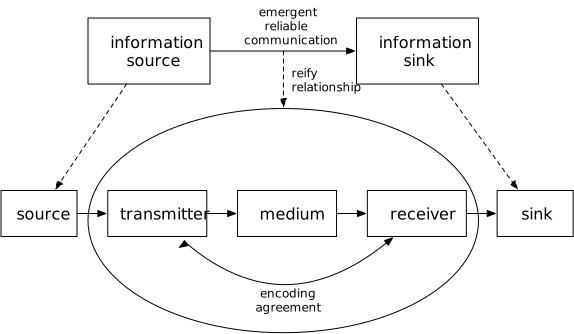
At a high level, communication involves an information source and an information sink. The source and sink have a functional relation of sending information from one to the other.
At the lower level, communication involves a set of components. The information source and sink remain. The functional relationship between them is reified by a chain of components: a transmitter, a receiver, and the medium between transmitter and receiver. It also involves various encodings used in sending from transmitter to receiver over the intermediate medium. The components have functional relations from one to the next, for moving information along this chain of components. The transmitter and receiver have a non-functional relationship: agreement on the encodings to be used to move information over the medium between them.
Neither the transmitter or receiver in themselves move information reliably from source to sink. Instead, reliable transmission is a simple emergent property of combining all the lower-level components and their relations. The reliability comes from properly matching the designs of the transmitter and receiver, including how they encode signals for transmission and reception, so that they can achieve the desired reliability on the medium that connects them.
12.4.1.2 Door closing and latching
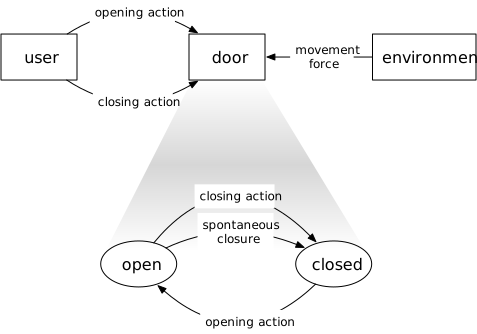
Consider a door, perhaps to a cabinet. The door can be open or closed. When open, it can be closed by a person acting to close it. If no one acts on the door, it might remain open or close on its own. When the door is closed, it remains closed until a person takes a specific action to open it. “Remaining closed” means that the door stays closed even when force up to some defined limit is applied to the door. These behaviors should occur reliably for at least some number of open-and-close cycles. They only need to hold reliably in some benign environment (no deforming forces, no corroding atmosphere, and so on).
This is an example of an emergent property of a high-level component that can be achieved by properly designing the subcomponents that make it up.

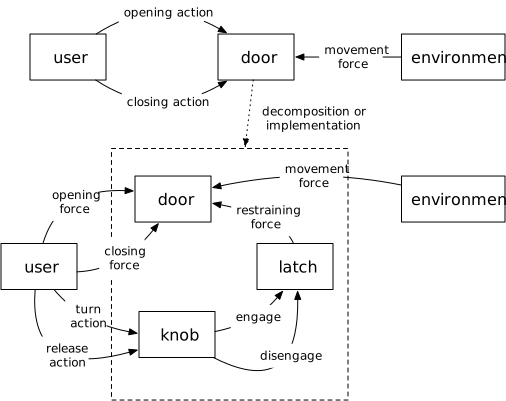
One possible implementation of the door that would meet this high-level property uses a latch to hold the door closed. When the door swings closed, the latch engages and keeps the door closed. The latch can be connected to a knob or lever that a person can use to release the latch, allowing the person to perform a two-part action to open the door (release the latch, apply force to the door to move it open).
The high-level door thus decomposes into three subcomponents: the basic door, a latch, and a knob. These three subcomponents, plus the door’s user, have four functional relationships:
- Latch to door: the latch holds the door closed when engaged.
- Knob to latch: the knob can be moved to disengage the latch.
- User to door: apply force to open or close the door.
- User to knob: apply force to turn the knob.
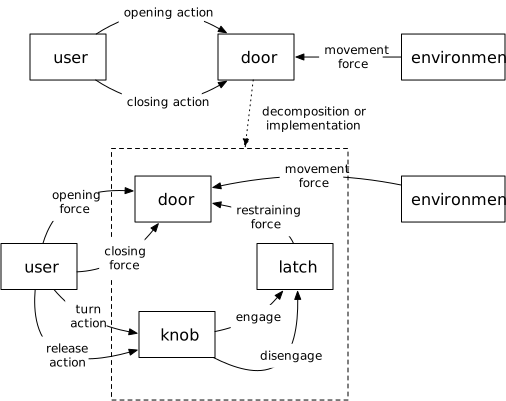
The high-level opening action that a user can apply to open the door decomposes into a sequence of lower-level actions: a turn action applied to the knob, an opening force applied to the door, probably followed by a release action on the knob. The high level closing action decomposes into, first, ensuring that the knob is released, then applying a closing force to the door.
The implementation admits states that do not directly map to the high-level states of the door. For example, the implementation allows the user to turn the knob and then take no further action. This leads to a state of the system where the door is in the closed position and the latch is disengaged. If the environment applies an opening force to the door, the door is not restrained and will swing open. A designer will have to work out what these intermediate states are, and determine whether they are acceptable or not. (In this case, the situation might be resolved by saying that the high-level “open” condition maps to any implementation state where the door position is not closed or the latch is disengaged. Handling intermediate implementation states is not always so simple.)
The knob and latch will have properties that, together, support the high-level property that the door will remain reliably closed through some number of open-and-close cycles. These properties likely involve constraints on the wear imposed on each of them each time the door opens or closes, and the amount of wear before they begin to be unreliable. Similarly, the property that a closed door stays closed when some amount of force is applied to the door decomposes into properties on the latch and knob to ensure they will hold the door in position.
The overall property of remaining closed is an emergent property of the design of the latch and knob. The latch by itself is not closed or open by itself; that is a property of the door that arises when the latch is engaged and the door is in a closed position.
12.4.1.3 Failure resilience
A failure resilient component is one that can mask one or more failures of its parts while continuing to provide correct behavior. This is one way to meet a goal that a component is reliable or available; the other way is to make the fundamental reliability of the component higher.
For a concrete example, consider a control system for an autonomous road vehicle. The control system takes in commands from a user or other outside system, then must provide correct, active control of the vehicle’s attitude and movement to travel on the commanded path. Typical acceptable failure rates are one in 10-7 to 10-9 operational hours. The vehicle should fail safely where possible when the control system fails, but I will leave that aside in this discussion.
Many systems achieve this level of failure resilience using redundancy and voting. In this approach, multiple independent processors run the control algorithm synchronously, each receiving the same sensor input and generating actuation output. The actuation output from each processor is fed to voting logic, which determines whether a majority of the processors are generating consistent output and if so applies that output to the plant being controlled. If one of the processors fails by stopping, or by generating different outputs, the voting logic masks out the presumed failure.
The combined components will generally perform the same operations as one single computing component by itself, but the combination will fail less frequently. This improvement is an emergent property of the combination. It depends on two non-functional relationships between the redundant components: that they all exhibit the same behavior, and that they generally fail independently.
For the example vehicle control system, I found that the approach of using three identical embedded computers was (based on reliability analysis, not measurement) likely to provide only a modest improvement to overall vehicle safety. The redundant computers were not fully independent: they ran the same code, they shared the same power source, and were subject to heat and vibration in the same environment, all of which increased the chances two or more computers would fail together. They had a greater degree of independence to matters like a cable vibrating out of its connector or dust shorting out traces on the boards. In other applications, such as spacecraft, there are more sources of independent failure, such as radiation upsets. For spacecraft and aircraft, the cost of unreliability is also higher than for a road vehicle, making this approach to redundancy worthwhile.
An incident involving an Airbus A330 landing on 14 June 2020 illustrates how lack of independence between supposedly-redundant computer systems leads to failure [TTSB21]. The Airbus A330 uses three flight control primary computers; on landing, these control the braking, thrust reversers, and spoilers that slow the aircraft on the runway. In this incident, there was an error in the flight control law implemented in all three flight computers. On touchdown, the flaw was triggered in one flight computer after another until all three had failed, leaving the pilots only manual control of the brakes. The pilots were able to apply manual braking to stop the aircraft before running off the end of the runway. The failure occurred because there was a design flaw common to all three flight computers, meaning that there was no redundancy in the face of the particular condition that occurred on that landing.
12.4.1.4 Undesired emergent properties
Components are usually designed and organized so that together they achieve the desired emergent system properties. However, the same design can exhibit other emergent properties that are undesirable.
Network congestion is a commonly-cited example of undesirable emergent behavior. In its simplest manifestation, when multiple streams of data meet and cross at some router in the network, the streams can overwhelm the router’s capacity to process and forward data. The router typically drops some packets in order to try to keep up, which causes some of the streams in turn to detect missing packets and retransmit them—causing even more traffic through the router. This was first observed in the Internet in October 1986, when a particular congested network link was moving about 0.1% of the data it normally could when not congested [Jacobson88].
This has led to congestion avoidance and congestion control mechanisms in Internet protocols, which aim to either keep stream data rates below the level when congestion starts or recover quickly when congestion does occur. The sender and receiver behaviors in the congestion control mechanisms, however, have been found to lead to behavior synchronization across multiple senders, leading to oscillating loads that repeatedly overwhelm a bottleneck, then back off, wasting resources for a while, until the cycle leads to another period of congestion [Zhang90].
These behaviors are similar to other situations where behavior is unstable, and once it starts to behave poorly it gets progressively worse. In many of these cases, congestion or overloaded conditions make it more difficult for mechanisms that would address the situation to work.
The lesson to draw from the possibility of undesirable emergent behavior is that system designs need to be analyzed to look for such negative behavior—not just analyzed to ensure that desired behaviors happen. This is related to a kind of confirmation bias Chapter 59 where one is motivated, usually unintentionally, to look for evidence that confirms what one wants or expects. It often requires deliberate effort to look for evidence of negative behavior.
12.4.1.5 Spacecraft imaging a ground location
The final example takes the basic principles in the previous, simpler examples and combines them into a realistically complex case.
Consider a spacecraft system that is intended to take images of ground locations and send those images to users on the ground. The system includes many different parts:
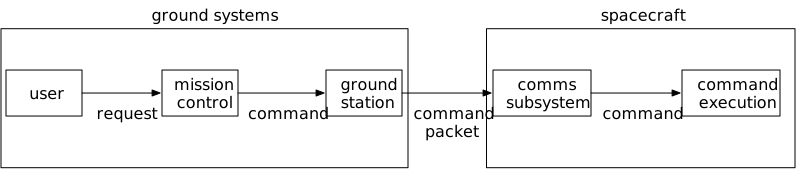
- A mission control center, where users can determine locations they would like imaged, generate commands for the spacecraft, receive images, and view the results
- One or more ground stations, with antennas and transceivers that can communicate with the spacecraft
- The spacecraft, which in turn includes:
- A communications subsystem, for exchanging messages with ground stations
- A control subsystem, which receives and executes commands from the mission control center
- An orbit determination subsystem, which might include a GPS receiver and logic for determining where the spacecraft is and how it is moving in orbit
- An attitude control subsystem, which controls the direction that the spacecraft is pointing and rotating
- A power subsystem, which provides power to other spacecraft components
- A payload subsystem, including an imager and memory for storing images
The process of taking an image involves every one of these parts, as well as others omitted from the example to keep the list from getting too long to read. It includes:
- A user determining what ground location to collect an image of;
- Formulating commands to take that image, and sending them to the spacecraft;
- Receiving the commands, decoding them, and executing them when the
proper time comes:
- Turning the spacecraft to point at the ground location, based on knowing where the spacecraft is and how it is moving;
- Powering up the imager, taking a picture, copying it to storage, and turning the imager off
- Packaging the image data along with related metadata for transmission to ground
- Sending the data to the mission control center by:
- Determining when the spacecraft is coming in range of a ground station;
- Turning on the transceiver;
- Encoding the image in packets and sending those packets to ground;
- Turning the transceiver off when out of range of the ground station;
- Repeating this sequence until all of the image has been transmitted
- Decoding the image in the control center and providing it to the user
If any one of those steps fails to happen properly, the system as a whole will fail to achieve its objective. At the same time, no one component involved in these steps achieves the system objective by itself. In other words, the system behavior of taking an image of a ground location is an emergent property of the system as a whole.
This example is typical of most system properties and behaviors, in that achieving the desired behavior involves many components working properly together. This implies that all these components have been designed to have their individual properties, and that the components have been wired together with the right functional and non-functional relations to work together.
This example also illustrates a common issue: that components depend on other components for their function. For example, the ability for the spacecraft to communicate with the ground depends on the spacecraft being able to determine when it is coming in range of a ground station. This means that the spacecraft must be able to tell where it is, which might rely on the GPS system. If there were to be a problem with the GPS constellation, the spacecraft would not be able to communicate correctly. This kind of dependency creates non-functional relationships—in this case, a non-functional relationship between ground station systems and spacecraft communications that communications will function only when the GPS constellation is working properly.
12.4.1.6 Safety and security
Leveson argues that safety is a fundamentally emergent property:
I argue that related properties, including security, are similarly emergent and must be understood, designed, and analyzed in terms of how components are related.
12.5 Working with structure
The notions of components, structure, and emergence form a foundation for the work to be done when designing and building a system. Upcoming chapters will define the tasks, artifacts, and processes involved in terms of this basic model of how systems can be organized.
For example, the design of a system consists of artifacts that document what the components are in the system, and the desired properties and relations that connect them. Verifying the design involves gathering evidence for and against whether the behaviors that emerge from the components and their relations match the desired system behaviors. A design can be evaluated based on properties of the graph of relations between components, and the graph of relations can guide investigations into whether subtle non-functional relations (such as expected component independence) will hold.
In addition, there are common design patterns of components and relations that provide guidance for implementing complex behaviors. These design patterns can be expressed in general terms of components and relations, making the patterns broadly applicable rather than specialized to a particular use case.