13.1 Introduction
Systems are too big for one person to understand all the facts at once. It’s necessary to focus on subsets to manage the scale.
At the same time, different people have different interests as they are working on a system. They need a particular kind of information about part of the system, but do not need to be distracted by other kinds of information.
These needs for subsetting lead to developing multiple views on a system. Each view defines a subset of the information on a system, with the subset defined to support a particular person’s needs and interests. Ideally, each person can do their work using one view or another, and when all the work has been done using many different views the work has addressed all of the system.
Some of these views have a technical focus, being about the function or properties of the system and its parts. These views support those who design, analyze, implement, or verify parts of the system. Other views are non-technical, supporting people who manage the project, organize the teams doing the work, handle scheduling, and similar tasks.
Views highlight some information and hide other information in order to help someone perform a task. If the view shows too much information, then the person using the view will have trouble finding the specific pieces of information they need. They may, indeed, be distracted by irrelevant information. On the other hand, if the view is hiding information that the person needs, they are likely to work with the incomplete information they have and infer that the system does not include the missing information.[1]
The view concept I am defining here is a general mechanism for subsetting information about the system. There are several architecture framework standards that define “view” and “viewpoint” concepts, including DODAF [DOD10] and ISO 42010 [ISO42010]. The view concepts in those framework standards arise from ideas about the processes that should be used to build systems well, and are thus more specific than the general idea presented here. These standards focus on developing models of a system’s design, with subset views that are motivated by exploring the objectives that system stakeholders have in the system. The approach in these standards is one way to use the general idea of subsetting information about a system based on some focus; I will discuss this further in later chapters when I turn attention to how to build systems using the foundational concepts presented now.
13.2 Technical views
Technical views are ones that subset the contents of a system in a way useful to the designers, implementers, or verifiers of the system. These views focus on how a part of the system functions or is organized in some technical sense.
These views can focus in different ways, depending on the specific need:
- On sets of related components;
- On paths through components to achieve some function; or
- On the dependencies of components or relations.
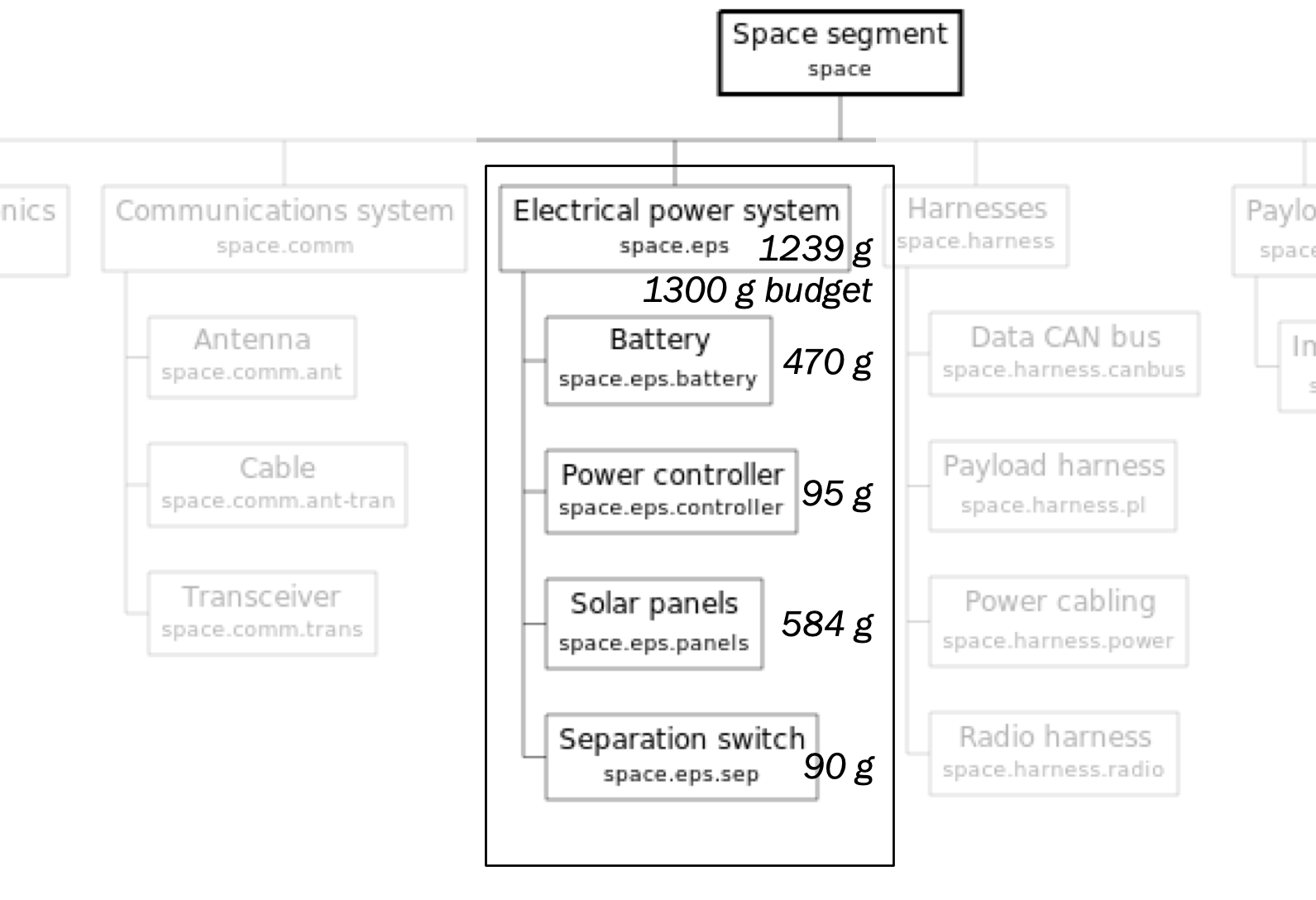
A view focused on a set of components is useful to someone responsible for a particular subsystem or abstraction. The view can collect all the components, at varying levels of abstraction, related to one part of the system. This might be defined as one or more subtrees in the component hierarchy (Section 11.3)—for example, all the components that make up an electrical power system for a spacecraft. This might also start from some other abstraction. Views like this can be used when working out how an abstraction is to be realized in concrete subcomponents (Section 12.3). It can also be useful for checking whether certain design properties hold, like total mass.
A view focused on a path through the system is useful for working out or checking how behaviors are realized. Such a view might start with an event in one component, then trace how one event causes events in adjacent components, onward until the high level behavior is complete. Views like this are useful when checking where a path might have gaps that need to be addressed. It is also useful for checking that a causal path among abstract components and relations is properly realized in concrete subcomponents.
Looking at a path can help reveal what conditions need to hold for each step in the path to occur properly. For example, in the spacecraft commanding example in the previous chapter, a ground pass has to happen successfully if a command message is to be received at the spacecraft. A successful ground pass requires a functioning and available ground station, accurate ground knowledge of where the spacecraft will be, knowledge in the spacecraft of where a ground station is and when it will be in range, and the ability to operate the communications subsystem.

The third kind of view focuses on trees or graphs of dependencies. This information is useful to someone who is verifying that some safety or security condition holds. It is also useful for revealing where there are unexpected vulnerabilities in a system. In particular, looking at the transitive closure of dependencies can reveal unexpected shared dependencies between two components. In the spacecraft commanding example above, a spacecraft’s ability to know when it should operate its transceiver for a ground pass might be based on the spacecraft knowing its location through GPS. This creates a dependency on a GPS receiver on board and the correct function of the GPS constellation. Further, it may require the spacecraft to maintain an attitude where GPS antennas can see the GPS constellation; this may conflict with other demands on spacecraft attitude (like pointing an antenna toward a ground station). Both the communications transceiver and GPS receiver may rely on a shared electrical power system.
These three kinds of views are not mutually exclusive. Often someone can benefit from starting in one view, such as a path through the system, and then use other views to explore or refine the system, such as checking on dependencies.
13.3 Non-technical uses
Some views are useful for managing project execution. As a manager or lead, I have been responsible for working out what tasks people need to do to develop the system to some milestone, along with potential dependencies among tasks and estimates of the time and resources needed. I have needed to understand the system in order to derive this information about tasks.
For example, I have often started with a high-level design for a part of a system, containing a few abstract components and relations and a few paths through them for performing key behaviors. I have used one or two paths through those components to sketch out milestones that the team can design and develop toward; at each milestone, the designs or implementations will be integrated to demonstrate some level of functionality. This management step uses views of a few paths through the system. After that, I have worked from the view of components and relations that feed into each milestone to work out a set of design and development tasks that will get each part ready for its milestone. These steps use information about the components and relations involved to work out both the individual tasks and how those tasks might depend on each other, leading to constraints in how the effort can be scheduled. I expand on these techniques in Section 20.6 and Chapter 50.
Following paths through a system, as well as tracing through the ways that abstractions are decomposed, allows one to find gaps in the current understanding. These gaps represent uncertainty, which can lead to risk. Further, following paths through the system that lead to and from some uncertainty to other components or relations helps one work out how much other parts of the system may be affected by uncertainty. This allows one to judge the potential effects of changes that may arise from the uncertainty; the magnitude of the effects is part of determining how much developmental risk some gap poses. I discuss how to use this kind of analysis in Chapter 65.