- 23.1 Introduction
- 23.2 Life cycle and development methodology
- 23.3 Key ideas
- 23.4 Purpose of life cycle patterns
- 23.5 A model for patterns
- 23.6 Documenting life cycle patterns
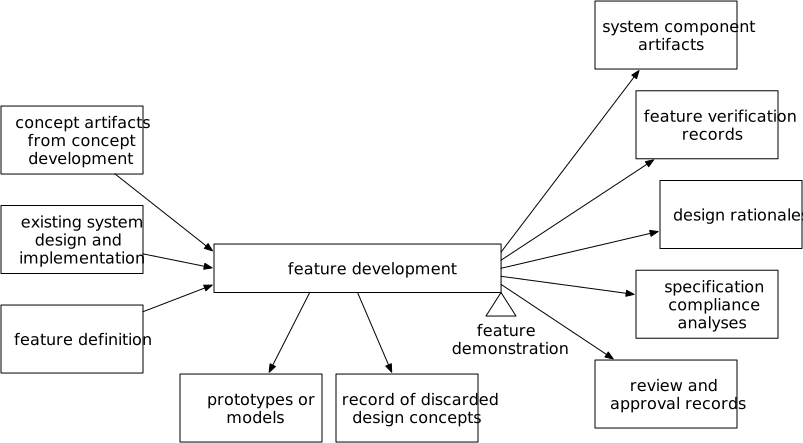
- 23.7 Work steps and artifacts
- 23.8 Life cycle and teams
- 23.9 Life cycle and planning
- 23.10 Principles for a life cycle pattern
23.1 Introduction
System building in general follows a common story.
A project to develop a new system begins when someone has an idea that people should make the system. At this initial moment, the system is largely undefined. There is a vague concept in a few minds, but all the details are uncertain.
The project then moves the system from this initial concept through to an operational system, and through the system’s operational life and eventual retirement. During development, the team will need to ensure steps are taken in order to produce a correct, safe system. Designs will be checked. Implementations will be tested. The system as a whole will be verified before being deployed into service. At the same time, the resources spent on building the system must be used efficiently, doing the work that needs to be done and avoiding the work that doesn’t need to be done.
Many projects continue system development beyond the first operational version, with ongoing development or problem fixes. Some projects include the steps to shut down and dispose of the system once it has completed its functions.
The life cycle is how a project organizes the way the team moves through this story. It is a pattern that defines the phases and steps in the work: what will come first, what will done before something else, when checks will happen. It provides checklists to know when some step is ready to be done, and when it should wait for prerequisites. It provides checkpoints and milestones for reviewing the work, so that problems are found and dealt with in a timely way. It provides an overall checklist to ensure that all the work that needs to be done is in fact done.
Section 20.4 introduced the basic ideas for life cycle patterns. These include:
- The life cycle usually includes multiple patterns for different parts of the work.
- Work is organized as a set of phases or steps, with milestones or checkpoints included in some steps. (I use the terms phase and step interchangeably; I generally think of a “phase” being longer than a “step”.)
- Phases or steps can be dependent on each other, with A depending on B meaning that work done in A will build on work done in B.
- A phase can have conditions that should be met before it starts, or that should be true when it is complete.
- Many phases and steps can be worked on in parallel.
- A path from one step to another following dependencies does not necessarily mean that the steps must be performed serially.
Each project will use its own life cycle patterns. The patterns may incorporate a framework that is standard for the industry or the parent organization. Selecting and documenting the patterns is an essential part of starting up a project, and people in the project should review how well the patterns are working for them from time to time and may want to improve the patterns.
In this part, I discuss life cycles in general. In Part VI, I present a reference life cycle pattern.
23.2 Life cycle and development methodology
Life cycle patterns are related to, but separate from, the development methodology that a team chooses to use, such as waterfall, spiral, or agile methodologies. I addressed these methodologies in the previous chapter (Chapter 22).
Speaking broadly, the development methodology determines how the work is organized in time: in a single sequence or iteratively, synchronized tasks or separate tasks, how far ahead to plan. The life cycle patterns reflect some of those methodology decisions and encode how to do different tasks.
Put another way, the life cycle patterns help organize what work the project has to do, and what dependencies there are among different steps in the work. The development methodology organizes how that work is planned and scheduled. As a result, the two go hand-in-hand but are distinct from each other.
23.3 Key ideas
Almost all project life cycle patterns, for both whole systems and for components, follow a similar overall flow. Abstracting from the story in the introduction, there are phases:
- Working out how the project will operate
- Identifying purpose
- Developing a concept
- Refining concept into specification and design
- Implementation
- Verifying the result
- Operating the system or component
- Evolving it over time
- Retiring the system or component at end of life
- Shutting down the project
For a whole system, this looks like:
Note that this flow starts with the system or component’s purpose. Good engineering always begins with having a clear understanding of what a thing is for. I have watched many engineers rush into designing and building a component without putting time into understanding what the component is going to be used for. By random chance their design has occasionally worked out to match what the component actually needed to do, but only rarely.
Understanding a system’s purpose or a component’s purpose also provides a way to bound the work. If one doesn’t know what a component is for, it is easy to keep working on a design without stopping because there isn’t a clear way to know when the design is good enough to be called done.
There are many points in this flow where one might add checks. At these times one can check on the correctness of the work. These checks improve system quality by building in the opportunity to discover and correct flaws before other work builds on the flawed work. Finding minor problems quickly usually means the cost of correction remains low.
There are also points where a project might have project-wide decisions--go/no go decisions or key decision points. These provide opportunities to check the entire project progress, sometimes occurring in the middle of other work, or at times when irrevocable actions are to be taken, such as funding, launch, or public announcements.
This general pattern applies recursively. One can start by creating a specification and design for the system. The system design will decompose the system into high-level components (Section 6.4). The act of defining a set of components implies identifying a purpose for each one, then specifying and designing each high-level component. The design of a high-level component might in turn decompose into a set of lower-level components, which in turn need a purpose, then specification and design.
The overall flow shows a move from high uncertainty at the beginning to lower uncertainty as the work proceeds. I will address managing using uncertainty in Chapter 65.
Finally, a project’s life cycle patterns will reflect the development methodology that the team has selected. Waterfall, spiral, and agile development all affect the contents of the patterns. I discuss this more in Chapter 22.
The life cycle is provides a general set of patterns for how work should proceed, but it should not define exactly how each work step should be done. That is left to procedures (Section 20.5), which should provide step-by-step instructions for how to do key parts of the life cycle. For example, if a life cycle phase indicates that a design review and approval should occur before the end of a design phase, then there should be a corresponding procedures for design reviews. That procedure should indicate who should be involved in a review, what they should look for, how those people will communicate about the results, who is responsible for approving the design, and how they indicate approval.
The life cycle patterns are the basis for the project’s plan (Section 20.6). The patterns are a set of building blocks that people in the project can use to develop the plan. The plan, in turn, guides tasking: the selection of which tasks (as defined in the plan) people should be working on next.
23.4 Purpose of life cycle patterns
Life cycle patterns address problems that projects have. They can help the team have a predictable and reproducible flow to how work should be done, so that everyone shares the same understanding of how the team works.
There are six ways that life cycle patterns help a project.
- Quality of work. The team must build a system that addresses the customer’s purpose, and in doing so must meet quality, safety, security, and reliability objectives.
- Efficiency. The project will be expected to deliver the final system as quickly as possible, at the lowest reasonable cost, while meeting the quality objectives. This means that the team needs to be kept busy doing useful work.
- Team effectiveness. People on the team need to know how to work together. Building trust depends, in part, on having shared expectations of how each person will do their work.
- Management support. Project management will need to plan and track the work in order to ensure the team meets deadlines and that they have sufficient resources to do the work.
- Customer and regulatory support. The customer may have specific milestones they expect the project to meet in support of the customer’s acquisition processes. Regulators often have similar expectations if a system must be certified or licensed for operation.
- Auditing support. The project’s work may be audited to check that the processes followed meet regulatory requirements, certification requirements, or as part of a legal review.
Gaining these benefits is not a result of using life cycle patterns per se; rather, it comes from using patterns that are designed to provide the benefits. For example, if the customer has an acquisition process that specifies certain milestones, then the top-level life cycle pattern for the project should incorporate those milestones. If the project is likely to have auditing requirements, then the patterns should include tasks to generate and maintain auditing records.
Quality of work. The purpose of a project’s approach to operations is, in the end, to produce a system for the customer that meets their objectives. This means it should do what they need, meet safety and security needs, and support future system evolution. In other words, the team’s work needs to produce a system with good quality.
Neither the life cycle patterns by themselves nor the plan that derives from them directly result in good product quality. System quality comes from all of the detailed work steps that everyone on the team performs. If they do their work well, and if mistakes they make are caught and corrected, then the system can turn out well. If some work is not done well, nothing in the life cycle patterns can prevent that.
However, the life cycle patterns can create an environment that will more likely lead to good quality. They can proactively make flaws less likely by ensuring that steps happen in order: identifying purpose and concept before design and implementation, for example. They can insert points in the work that encourage people to think through what they should design or implement. They can also avoid problems by providing a checklist for what should be complete at the end of a work step. They can ensure that when a system is delivered, all the work needed to put it into operation is complete. They can build in checkpoints for reviews and verification to catch problems early. They also help project management organize the work so that it is complete, that is, so that no parts of the system or some work steps are overlooked.
Sometimes the value of a life cycle pattern will come from slowing down work. Most of the work done on a project is done by people who are focused on a particular part of the system; it is not their job to manage how the project goes as a whole. Their job is to get that one part designed and built, according to the specifications they have been given. If the specialists start building before the context for their work has been established, they are likely to design or implement something that does not meet system needs. I have been part of more than one project where the resulting rework caused the project to be canceled or required a company to get additional funding rounds to make up for the resources spent on the mistakes.
Efficiency. Most systems projects will be resource-bound, with more tasks than there are people on the team to do them. In this kind of project, it is important to keep each person busy with useful work. This means that nobody on the team is blocked with no tasks they can usefully perform. It also means that almost all the tasks that people perform contribute to the final system—that there is little work that has to be thrown out and redone because it had flaws that made it unusable.[1]
As project management builds the project’s plan, using the life cycle patterns as building blocks, they must detect where there are dependencies between work steps and plan the work steps so that later steps are unlikely to get blocked. For example, if some part will require an unusually long time to specify and acquire from an outside vendor, then the management will need to ensure that work on that part starts early. The life cycle patterns provide part of the structure on which the plan is based, and provides a template for some of the dependencies.
Life cycle patterns can also help avoid unnecessary rework. This comes partly from the ways that the patterns help improve the quality of work. In particular, a good life cycle pattern can lead people to take the time to think through the purpose and specification of something before they jump into design and implementation unprepared, and then build something that does not meet the system’s needs.
Finally, the patterns can help bound the work to be done. When a project does not define the scope of work to be done, it is likely that someone will start working on something in excess of or not related to the customer needs. Good patterns help avoid this by defining an orderly and thoughtful process for identifying what work needs to be done.
Team effectiveness. Members of an effective team respect and trust each other. Having shared norms and understandings for how work is done and how people communicate is important as part of the environment that allows the team to develop respect and trust.
A defined life cycle for a project addresses part of this by defining a common understanding of how work should be done. Good patterns define expectations of what will be done in different work steps. Everyone on the team can agree when a work step has been completed. Good patterns also create times when people know they are expected to communicate about some work step. This makes it easier for someone to trust that they will be consulted at appropriate points about work that might affect what they are doing, so that they do not need to create separate, ad hoc communication channels or try to micromanage something that is not their direct responsibility.
As I have noted elsewhere (Section 20.9.2), the life cycle patterns can only have this benefit if the team actually follows them.
Management support. The team, or designated parts of it, will be responsible for making a plan (Section 20.6) for the project’s work, then coordinating and tracking the resulting tasks. The life cycle patterns provide templates for the tasks that will go into the plan, and the key milestones that anchor the work. The life cycle sets the pattern for phases that the project will go through, such as initial conception, initial customer acceptance, concept exploration, implementation, and verification. The cycle also sets the pattern for milestones that gate the progression from one phase to another, such as a concept review, a design review (and approval), or an operational readiness review.
The plan will change from time to time, both in response to external change requests and as the project progresses and the team learns more about the work ahead. Sometimes the need for change occurs gradually, with an issue slowly manifesting itself but causing no acute problem that causes people to recognize there is a need for change. A good life cycle will build in times for people to step back to get perspective and detect when there is a slow-building problem to address. Review milestones are often a good time to plan for this.
Having life cycle patterns and corresponding procedures that apply when these changes occur will help the team adjust their work in an orderly way. It will help them ensure that steps don’t get missed as they work out how to change the plan (and the system being built).
Good life cycle patterns can help a project steadily decrease its uncertainty and risk as work proceeds. Most of the time, a project will start with high uncertainty about what the system will look like, and early project phases result in increasing understanding of what the system will need to be. This process will repeat at smaller scales: once the general breakdown of the system into major components is decided on, each of those components will start with high uncertainty about how it will be structured. The uncertainty about the major components will then gradually resolve, and so on. However, this occurs when the project is guided in a way that uncertainty is addressed systematically, not haphazardly.
Customer and regulatory support. Many customers will have a process they go through to decide whether to build a system and to track its development process. For US governmental customers, much of the process is encoded in law or regulation, such as the Federal Acquisition Regulation (FAR) [FAR] or Defense Federal Acquisition Regulation Supplement (DFARS) [DFARS]. The process governs matters like which design proposal is selected for contract, providing evidence of good progress, providing information that determines periodic contract payments, accepting the finished system, and determining whether the project should continue or be terminated.
These customers will expect deliverables from the project from time to time. The life cycle process must ensure that there are milestones when these are assembled and delivered. (It is then the job of project management to ensure that these milestones, and the tasks for preparing deliverables, can be completed by the time line that the customer requires.)
Whether the customer requires explicit intermediate deliverables or not, formally involving the customer may be important for keeping the project on track.
Similarly, regulatory bodies have processes by which a system that must be certified or licensed before operation can apply for that approval. Those processes will define activities that the team must perform, along with milestones and deadlines by which applications must be submitted or approvals received.
Auditing support. A project’s development practices may be audited for many reasons. Auditors may perform a review as part of an appraisal or certification against standards, such as CMMI [CMMI]. They may review processes to ensure compliance with regulatory standards, especially for security-sensitive projects. The processes may also be audited as part of a legal review. These reviewers need to see both the entire definition of processes, including the life cycle patterns, as well as evidence of how well the team has followed these practices.
23.5 A model for patterns
Each project will have several life cycle patterns, each covering a different part of the work.
Each pattern is defined by its purpose, the circumstances in which it applies, the phases or steps involved, and the dependencies among the steps. It should also include rationale that explains why the pattern is structured the way it is. In a previous chapter I used the example of a simple pattern for building one component:
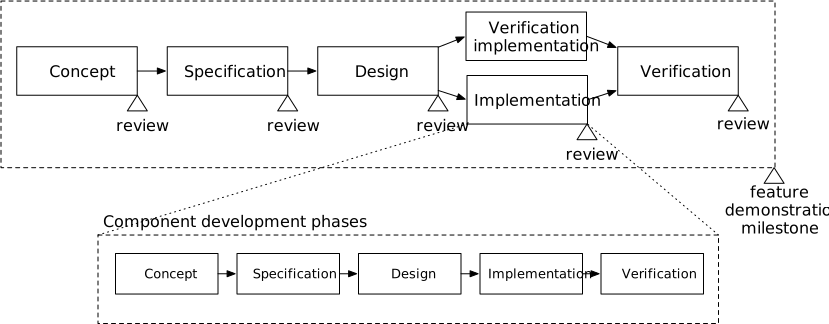
This pattern applies to building one low-level component where the purpose of the component is already known, and the component is straightforward to design and build in house. Similar but slightly different patterns might apply when the component has to be prototyped before deciding on a design, or when the component is being acquired from a supplier outside the project. This pattern would be used as one part of a larger pattern for building a higher-level component that includes this one.
Each phase of a pattern defines a way to move part of the work forward. It should have a defined purpose that defines what work should be achieved in that phase.
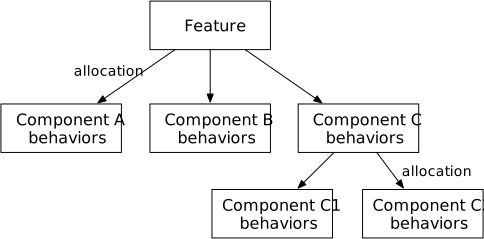
The details of the phase are defined by:
- Preconditions: what conditions should be true when a phase is ready to start. A list of conditions for starting the phase, beyond the artifacts that should be ready.
- Input artifacts that should be available at the beginning of the phase, and their maturity or completeness level.
- Actions that are to be taken to begin the phase.
- What work should be done in the phase, and the artifacts developed in the phase.
- Milestones to be met during the phase.
- Actions taken to end the phase.
- Output artifacts that should be available at the end of the phase, and how complete each one should be.
- Postconditions that define what should be true when the phase has completed.
Each action should also indicate who is responsible for performing that work. The responsibility will usually be defined as a role, not a specific individual. For example, a component design phase might involve three actions: design the component, review the design, and approve the design. The design action would be the responsibility of the component developer; the review action would be the responsibility of the developers responsible for components that interact with the one being designed, and the approval would be the responsibility of a systems engineer overseeing some higher-level component of which this one is part.
The rationale for this example design phase might say:
- The purpose is to work out a design for the component that meets its specifications, including its relationships with other components in the system structure and its safety, security, reliability, and performance objectives.
- A separate design step between specification and implementation gives time to think specifically about this component, and to document its design for future developers who may need to revise the design.
- The review actions provide an independent check that should improve the likelihood of this component working correctly as part of the system by looking at the design from a point of view that has not been intimately involved in working out the design.
The actions defined for the phase should reference the procedures for doing those actions, when those procedures are defined. For the example design review action, the procedure might be:
- The component developer notifies the review group that their review is needed;
- Each reviewer in the review group acknowledges that they will provide the review;
- Each reviewer checks the design against the relationship that component has with their own components, and against the specification for the component being reviewed;
- Reviewers give feedback to the developer, indicating whether they are satisfied or not;
- When all reviewers are satisfied, they inform the developer.
- If one of the reviewers detects a more serious problem with the design that cannot be resolved by feedback to the developer, the reviewer should use another procedure to raise the issue up to a higher level.
The procedure might also name the tools to be used (an artifact repository for the design, a review workflow tool for the reviews).
23.6 Documenting life cycle patterns
A team needs clear documentation of the phases if they are to execute them properly. A team can’t be expected to guess at what they need to be doing, or how their work will be reviewed; it needs to be spelled out.
This documentation is assembled during the project preparation phase. The details are usually not completely worked out before any other work is begun; rather, “project preparation” more often proceeds in small increments, working out the rules shortly before the associated work begins.
Each life cycle pattern should have a purpose, and the steps or phases in the pattern should be checked that they can achieve that purpose (and that there is no extraneous work in the pattern).
A pattern should also have an explanation of when it applies and when it does not. For example, there may be multiple patterns for designing a component: one for a simple component that is built in house; one for a component that is outsourced to a supplier; one for a high-level component that is made up of several lower-level components; one for a component that requires investigation or prototyping before deciding on a conceptual approach to its design. All these patterns likely have a lot in common, but procuring an outsourced component will have contracting steps that an in-house component will not.
Someone using the documentation should be able to tell accurately whether they are using the correct version of the patterns. The life cycle patterns will be revised from time to time—as the team grows and as people find ways to improve how they work together. This means that the material that a user sees should indicate not just a revision number but have a clear indication of whether the version they are looking at is not longer current.
The form of the documentation is not as important as the content. It can be a written document. It can be made available electronically, with structured access and search capabilities (such as in a Wiki). Some companies offer tools that help define and document development processes or life cycle patterns, including definitions of phases. What matters is that each person who needs to use the documentation can do so conveniently and accurately.
23.7 Work steps and artifacts
Each phase or step has a number of artifacts that the team must develop. At the end of a phase, some of those artifacts need to be complete (allowing for future evolution), and others need to have reached some defined level of maturity. The work in a phase consists of the tasks that develop those artifacts.
I discussed artifacts in Chapter 17. The artifacts are the products of building the system, including the system being delivered as well as documentation of its design and rationale, records of actions taken during development, and information about how the project operates.
These artifacts are the inputs and outputs of the work specified in life cycle patterns (and the associated procedures). Using the component design step example, the work uses:
- The purpose and rough concept developed for the component;
- The specifications developed for the component;
- Documentation of the relations between this component and others, both functional and non-functional; and
- The purpose of the system and of higher-level components of which this one is part.
The design step produces:
- A design document for the component;
- Analyses of the design showing whether it will meet its specifications or not;
- Records of the rationale for why the design was chosen; and
- Records of review and approval of the design.
In general, every artifact involved in building the system should be a product of some work phase or step, and every input or output of work steps should be included in the set of artifacts the team will develop. Ideally, the life cycle patterns will be checked for consistency with the list of artifacts the project uses.
Artifacts are developed at different times during the course of a project. A few artifacts should be worked out as the project is started—especially those recording the initial understanding of the system’s purpose and initial documentation of how the project will operate. These will be refined over time. Other artifacts are developed during the course of development, and the life cycle patterns indicate which ones are to be worked out before others. The artifacts will be in flux during development: the team learns about the system as it designs and develops it; the customer or mission needs often change over time; flaws get discovered in designs or implementations.
Many of the project’s artifacts support how people work together, and the life cycle patterns should reflect these communication needs. For example, one person may work out the protocol that two components need to use to communicate with each other. Two other people may design and implement the two components. The interface specification that the first person develops serves to communicate the details of the interface among all three people. The patterns should record that the design and implementation work steps depend on the work to develop the interface specification. Later, if one of the component developers identifies a flaw in the interface, the people involved can work through how to revise the interface—and the revised specification artifact informs each person how to update their work to match the change. The pattern helps to show how information about a change to the interface specification triggers rework on dependent artifacts.
A good life cycle pattern has procedures to manage the change in artifacts, and how those changes affect other artifacts downstream from them. There are two separate problems these procedures must address:
- Managing how changes are coordinated across multiple artifacts and through the team while a part of the system is in development; and
- Ensuring that when a part of the system is complete, all the artifacts are consistent with each other.
Different life cycle patterns approach this in different ways, which we will discuss in later chapters on different patterns. The most common approach is to maintain different versions of an artifact, with at most one version being designated as a baseline or approved version, and other versions designated as works in progress. Many configuration management tools have a way to designate a baseline version, and many software repository tools provide branching and approval mechanisms to track a stable version.
23.8 Life cycle and teams
What is the team size and background? How is it expected to change over time? A small team can often be a little less formal than a large team, because the small team (meaning no more than 5-10 people) can keep everyone informed through less formal communication. A large team is not able to rely on informal communication, so more explicit processes and communication mechanisms are important. Many teams start small when the project is first conceived, but grow large over time. A team that will grow will need to communicate more formally from the beginning than they otherwise might so that as they add people to the team, the larger team works smoothly.
Conversely, if the life cycle patterns indicate that some action will be performed by some person, does the team actually have the staff to do that work? When a project says that some work is to be done and then does not staff that function sufficiently, it sends a message to the team that they should not take the process as written seriously. This undermines the team’s trust. If the function is actually needed, either the team will find an ad hoc workaround or the function will not get done adequately. Either way, there will be a disconnect between what is written down and what actually happens.
23.9 Life cycle and planning
The life cycle patterns are just patterns that provide a guide to work that goes in the project’s plan. The plan is the actual definition of the tasks to be done. When the plan needs to be updated, the patterns provide a template for the work that goes into the plan.
Assembling the plan, however, takes into account many inputs, of which the pattern is only one. Planning involves deciding on the priority and deadlines for work, which is based on project deadlines, risk or uncertainty, and the project’s development methodology.
Chapter 64 discusses in detail how the plan is developed and maintained, including how the life cycle patterns get incorporated.
Consider the following example of how a pattern gets incorporated into the plan. This example shows how the pattern is only a template, and there are many decisions that will depend on other information.
This pattern defines what should happen when a customer requests a change. The basic pattern is that first someone on the team should evaluate the request; this may involve working with the customer to clarify the request, and with other engineers to estimate the scope and cost of the work. The project can then make a decision whether to accept the change or not. If the decision is to make the change, work to build, release, and deploy the update will follow. If not, there is another pattern for how to communicate with the customer that the change will not be made.
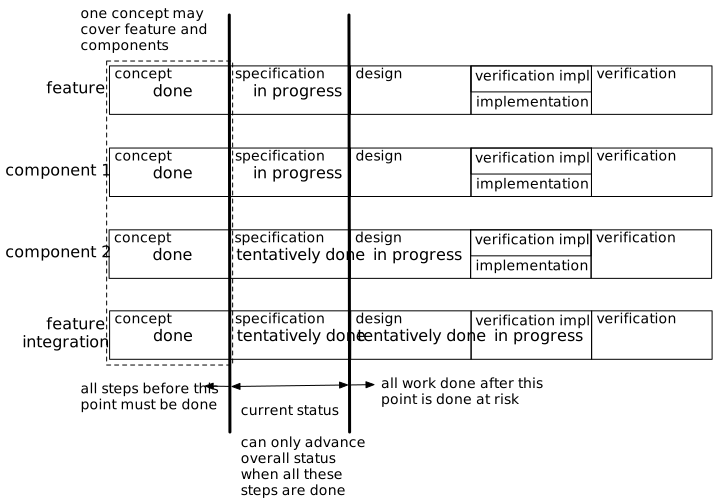
The activity starts when the project receives a change request. Based on this, the plan can be updated to include three tasks right away: the evaluation, review, and decision tasks.
At the same time, the planner must make decisions: who should each task be assigned to? What priority should the flow of tasks have? The pattern can indicate the roles involved in the tasks, such as there being a small team responsible for evaluating change requests and a customer representative from the marketing team, but it doesn’t determine which specific people. That’s for the planning and tasking efforts to determine. Similarly, the pattern does not specify how the work should be prioritized relative to other work the same people are doing. The planner incorporates information about how urgent the customer’s request might be and the importance of the customer into the decision. The project might have decided, for example, that there should be a queue of outstanding change requests and they should be evaluated in their order in the queue.
Determining who should be involved in a review of the evaluation might depend on the results of the evaluation. The pattern might indicate that the evaluation should be reviewed by engineers responsible for each high-level component that will be affected by the change. This means that the decision about who specifically will be tasked with the review can’t be made until the evaluation has worked out the scope of the change.
The decision to proceed with making an update will depend in part on whether the team has the time and resources to make the update. The team will need to determine whether adding the work to the plan will cause a problem with meeting deadlines that have been established already, or if it will overload a team that is already busy. This determination will involve analysis of the current plan—something that the life cycle pattern can help with only to the extent that the patterns can help with generating estimates of the work that would be involved.
When the project takes the decision to go ahead with developing an update for the request, the pattern shows that work steps follow to develop a change and then release and deploy the update. When the decision gets made, this will trigger the planning activity to add development and release work into the plan. These are high-level work steps with little detail. The planner will find patterns for these steps and populate those patterns into the plan.
Decisions about the work involved in development will depend on the development methodology that the team has selected to follow. If the update will involved extensive changes and the team is following a spiral-style methodology [Spiral], the development plan might consist of two or three development rounds. Each round would design and implement part of the changes, with a milestone at the end of each round showing how the partial changes have been integrated into the system.
Decisions about the release and deployment work will also incorporate policy decisions about how the team works. Will each change request result in a separate update release? Or will updates be bundled together into releases that combine several updates, perhaps on a schedule defined in advance?
23.10 Principles for a life cycle pattern
In this section I list some principles to consider when designing a workflow pattern.
The act of designing—or refining—a life cycle pattern is an opportunity to think deliberatively about how the team should get its work done. Life cycle patterns are the templates for the project’s plan, and so they should be designed to achieve the work that is needed to move the project forward well.
Designing the patterns ahead of time means having time to define good work patterns. The pattern does not have to be worked out under pressure, as a reaction to something unexpected happening in the project. It can be discussed among multiple team members to get different perspectives and to ensure everyone’s needs are met. Working in advance gives time to check that the steps in the pattern are consistent with each other. It means that there is time to think about what exceptional situations might happen and define what to do in those cases.
Note that if an organization already has an approach to life cycle patterns, whether documented or not, one should aim for continuity with that approach. Anyone already in the organization will know that approach to organizing work; making a major change would mean losing the advantage of established team habits. On the other hand, if the current approach is not working well, then a new project is an opportunity to improve.
The life cycle patterns encode principles and methodology that encourages good work. Principles to consider include:
- Know the purpose for something before developing it.
- Build in time for and incentivize deliberative thinking.
- Assign decision-making authority to an appropriate level based on the nature of the decision.
- Build in ways to check work, and design them so they are a team norm and not prone to triggering defensive reactions.
- Build for the longer term.
- Build in project-wide decision points.
- Think about exceptions that might happen, how to handle them, and when to change course.
- Define the work so that everyone on the team can agree when a step has been completed.
- Give a clear definition for each step of the quality considerations by which the work can be judged.
- Make the pattern as light-weight as possible without compromising quality.
Purpose. I have mentioned this principle several times already, and I believe it is a basic principle of effective system-building. The life cycle patterns encode this principle for specific parts of the team’s work.
As with anything else that is designed, a pattern itself starts with a purpose. That purpose might be “build a simple component” or “build the whole system” or “handle a customer’s change request”. A good pattern addresses its purpose thoroughly, without trying to achieve other purposes.
The pattern that results should then ensure that team members follow this approach when building parts of the system. If the pattern is for handling a customer’s change request, for example, the pattern should address understanding and documenting what the customer wants changed (and why), before starting to work out whether to agree to the change or to begin implementing the change.
Time to think. Key parts of a complex system are best served by taking some time to properly understand the purpose or need of that part, and to look at options for how it can be designed or built. A project running at too fast a pace skips this thinking and uses the first thing that someone thinks of—though there may be subtle ramifications of that decisions that are not appreciated until the decision causes a problem later. Asking someone to document the alternatives they considered and rewarding them to do so works to improve the quality of the system.
At the same time, people can take too long to make a decision or fixate on making it perfectly. The time spent on deliberation should be bounded to avoid this.
Decision-making authority. Bezos introduced the idea of reversible and irreversible decisions [Bezos16]. He wrote:
Some decisions are consequential and irreversible or nearly irreversible—one-way doors—and these decisions must be made methodically, carefully, slowly, with great deliberation and consultation. If you walk through and don’t like what you see on the other side, you can’t get back to where you were before. We can call these Type 1 decisions. But most decisions aren’t like that—they are changeable, reversible—they’re two-way doors. If you’ve made a suboptimal Type 2 decision, you don’t have to live with the consequences for that long. You can reopen the door and go back through. Type 2 decisions can and should be made quickly by high judgment individuals or small groups.
As organizations get larger, there seems to be a tendency to use the heavy-weight Type 1 decision-making process on most decisions, including many Type 2 decisions. The end result of this is slowness, unthoughtful risk aversion, failure to experiment sufficiently, and consequently diminished invention.
For engineering projects, many decisions fall in the middle ground between reversible and irreversible. Consider building an aircraft. As long as the designs are just drawings, the designs can be changed with low to moderate cost. Early in the design process changes can be quite low cost; as the design progresses and more and more interdependent components are designed, the cost of rework increases. Once the airframe has been machined and assembled, the cost of changing its basic design becomes high, possibly high enough in time or in money that it is in effect irreversible.
Good life cycle patterns will account for different costs of reversing decisions. They should both build in time for deliberation and consultation before making hard-to-reverse decisions and use lighter-weight decision-making for less risky decisions. Similarly, the patterns should ensure that the authority for hard-to-reverse decisions is assigned to someone with high-level responsibility in the project, while the authority for low-risk decisions should be placed as close to the work as possible.
Checking work. Checking that work has been done well is commonly understood to improve the quality of results. It is essential for parts of a system that require high assurance—safety- or security-critical parts.
The key to checking is that the checks not be subject to implicit biases that the developer might have. This can be handled either by the developer doing analyses that force a stepping back from decisions (perhaps by encoding them mathematically) and that can be checked for accuracy by someone else, or by having an independent person review the work.
Either way, the developer’s pride in their work can feel threatened. Setting out life cycle patterns in which every part of the work is checked enables the project to make checks a norm. Designating in advance that checks will happen, and who will do them, helps depersonalize the effort and in the long term contributes both to quality work and team morale.
Building for the longer term. It is easy to solve an immediate problem at hand quickly and move on, leaving a problem for the future. Taking time to think about the problem (the principle of taking time for deliberative thinking, above) will help but is not sufficient.
It is likely that someone will revisit the work sometime in the future. They may need to understand the work in order to fix a flaw or make an upgrade. They may be auditing the work as part of a critical safety review. They will need to know the rationale for decisions that were made, and they will need to understand subtle aspects of the work. If this information has been documented, these people in the future will be able to do their work accurately and relatively quickly. If they have to deduce this information by looking at artifacts built in the work, they will have to spend time reverse-engineering the work and their accuracy is generally low.
Building into the pattern checks for documentation of rationale and explanations will accelerate future work.
Project-wide decision points. Most projects have times when there is a decision whether to proceed or to cancel or to redirect the project. These include whether to start, times when funding is needed, public announcements, and irrevocable steps like launch. These decision points generally require work to prepare for them, which should be accounted for.
Exceptions. Things often go not to plan. What then? Who needs to know? What needs to be done to respond?
Sometimes this is as simple as setting an expectation for the team. If a component’s specification is inconsistent or cannot be met, who gets informed, and how does the problem get corrected?
Sometimes the situation is time-critical. If a major piece of equipment catches fire, what is the response? What if an insecure component has been incorporated and deployed? What if a large part of the system has been built, and someone finds a fundamental flaw? The responses to situations like these are complex, and there often isn’t time in the moment to work out the details.
Good life cycle patterns include pre-planned responses to these exceptional situations. This might consist of references to procedures that should be followed, or it might reference a pattern used to respond to the situation.
Completeness. Can everyone on the team agree when a part of the work has been completed? The person assigned a task should understand their assignment, so that they can do their work independently. Others will check the work, or mentor the person doing the work—and they should have the same understanding of the assignment.
The definition of actions, as well as the list of outputs and post-conditions for a pattern, should be clear to everyone.
Quality considerations. As with completeness, the people assigned to work on tasks need to have a clear definition of what makes the results of their work acceptable, or what makes one way better than another. Sometimes this is simple: when objectives or specifications, which would be inputs to a work step, are met. Other times considerations of quality arise not from specifications but from things like coding standards. In those cases the quality considerations should be spelled out explicitly so the people doing the work know to use them.
Light-weight patterns. Good patterns are lightweight enough to get their job done, and not more (Section 20.9.2). Working out the pattern in advance is an opportunity to work out what parts of the work are truly needed and which can be omitted or simplified. For example, a pattern should be adapted to the possible cost of making a wrong decision (see decision-making authority above). Patterns that involve easily-reversible decisions should include streamlined decision-making steps, pushing the decision authority to as low a level in the team as possible and involving as little work as possible. On the other hand, more difficult decisions should involve a pattern that calls for greater deliberation, more checking and consultation, and places decision-making authority higher in the team’s hierarchy.
Similarly, the patterns should be achievable by the team. If the team is small, it makes no sense to mandate complex work flows for which there isn’t the staff. Each decision about what to include in a pattern should be measured against what is possible for the team to perform.