- 21.1 Purpose
- 21.2 Tasks
- 21.3 Defining tasks
- 21.3.1 Component breakdown structure
- 21.3.2 Artifact patterns
- 21.3.3 Mapping artifact patterns onto breakdown structure
- 21.3.4 Development methodology and life cycle patterns
- 21.4 How work grows and changes
- 21.5 Managing artifacts
- 21.6 Uncertainty and choosing tasks
- 21.6.1 Uncertainty versus risk
21.1 Purpose
Project operations is about the tasks that people do in the project. The next chapters focus on project operations, expanding on the material in Chapter 20. I discussed there how project operations can be broken down into parts to make it more tractable: development methodology, life cycle, procedures, planning, and tasking.
- Development methodology (Chapter 22): The general approach the project takes to organizing its work, such as whether to work in iterations or linearly, how large tasks should be, and whether to work on tasks independently or synchronously.
- Life cycle patterns (Chapters 23 and 24): the sequences of steps and tasks used to complete various phases of the project, and how those steps and tasks depend on each other.
- Plan (Chapter 64) and tasking (Chapter 68): tracking the overall path to completing the project, and making decisions about who should work on which tasks at what times.
The reasons to organize work include making efficient use of people and resources, with little wasted work and avoiding idle time, and ensuring good quality in the final system. Section 7.3.5 and Section 20.1 provide further details.
The model of work I am using focuses on creating and organizing system artifacts (Chapter 15). The artifacts are mostly organized around components, with each component described by a defined set of artifacts. (A few other artifacts are used in project operations or project support.) The work is performed as tasks that take in some artifacts and do work to generate other artifacts.
Operations is about working out the right tasks to be done, then when to do each one, and keeping going as the tasks change.
The rest of this chapter begins with defining tasks: how most of them involve building the artifacts that define each component, and how one artifact builds on information in other artifacts. The project’s development methodology influences how the work of building the artifacts is broken into tasks. Building a component includes tasks for checking work and decision points along the way. The tasks will include decision points that cut across many threads of development.
The discussion next moves to how the known set of tasks changes as a project moves along. As the team defines new components, they implicitly define new tasks to design and implement those components. As the work progresses, there will be problems to fix or changes requested, each of which involves more tasks.
Finally, the chapter wraps up with a discussion of how to choose what tasks to work on when. These decisions can be framed in terms of uncertainty, and how different choices lead to increasing or decreasing the uncertainty in the system’s artifacts.
21.2 Tasks
A task is a unit of work that one or more people will perform. The common understanding of “task” is generally sufficient. The work creates and updates the artifacts that make up the system.
In Section 20.4, I introduced the general idea of a life cycle pattern: a set of phases or steps, with dependencies from one phase to another. Each phase or step is made up of some tasks, tasks having dependencies among themselves. Phases can have milestones; milestones are themselves tasks. Tasks are assigned to and performed by one or more people.
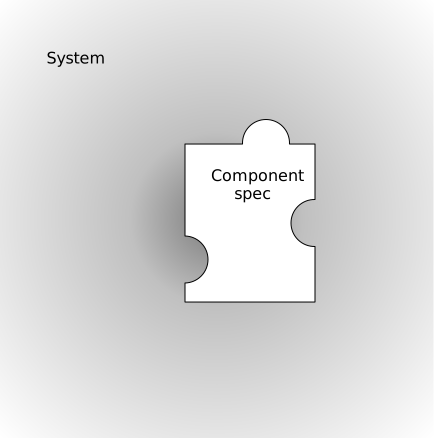
The work done in a task uses some artifacts as inputs and produces or updates some artifacts as output. The dependencies between tasks come through artifacts that are outputs and inputs to tasks.
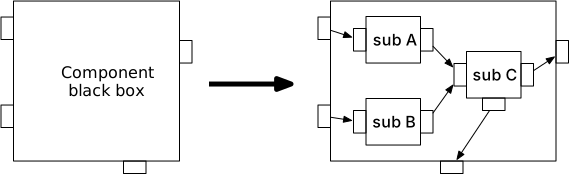
21.3 Defining tasks
The easiest way to understand how tasks are defined is to suspend disbelief for a bit and pretend that one knows all of the components in the system. This is, of course, unrealistic: the only time when one actually knows everything is at the end when the system is complete. One can begin by looking at all the components and mapping out the work to be done with full knowledge, and then see how to work in a more realistic situation where much of the system is not yet known.
The basic approach to defining tasks starts by working out the system artifact graph, based on the components in the system, and then working out the tasks needed to build all those artifacts well.
21.3.1 Component breakdown structure
Defining tasks starts with the component breakdown (Section 11.3). At the end of the project, it names all the components in the system and shows how one component is a part of another. The system as a whole is the top level of the breakdown structure. The breakdown structure will not be complete until late in the project; components will be added and removed as the work proceeds.
This example is of a simple small spacecraft. A real mission system would include many system components in parallel, including ground systems and launch vehicle.
21.3.2 Artifact patterns
For each kind of component, there is a map of the artifacts involved and the dependencies between them—how one artifact builds on previous ones.
Dependencies include tracing: a fact recorded in one artifact is the reason that something exists in a following artifact. One of the principles of a good set of system artifacts is that every part of every artifact can be traced back to a need in the system purpose, and that every part of the system purpose is realized in implementation artifacts and verified in other artifacts.
Bear in mind that these are artifacts, not tasks. Tasks make and update artifacts. One could do a simple mapping from artifacts to tasks, having one task to make each artifact in turn. In practice that doesn’t work, as I will discuss in a later section.
The artifacts involved depend on the kind of component though they have elements in common. All components start with a purpose and end with verification. Each specific project may use a different variant of these artifacts, depending on its needs. Here are four examples.
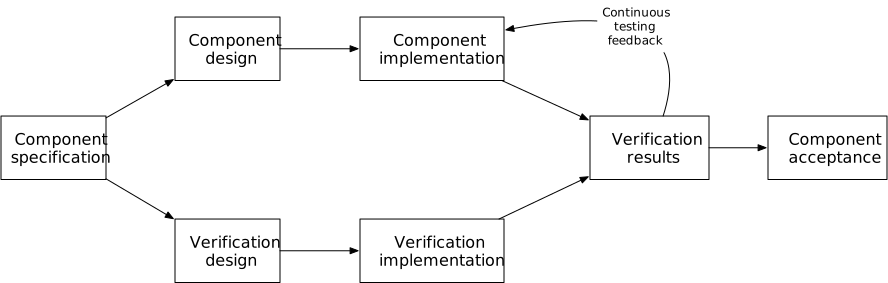
A simple regular component. Most components that are developed in house follow this base pattern of artifacts. It starts with a purpose, proceeds through concept and specification, then to design and implementation on one track and implementing and performing verification on another track.

A component supplied by a vendor. When a vendor designs and implements a component, there are additional artifacts related to selecting the vendor and the contract with them. The vendor may be responsible for the component’s design and implementation, but the project will still maintain a design and implementation that are received from the vendor.
System as a whole. The major artifacts for the whole system are similar to those for a component, with two main differences: records of how the project worked out the system’s purpose, and validation of the system against the stakeholder needs.
System built under contract. A system that is built under a competitive contract to someone else has additional artifacts (and the order of work is somewhat different). The project develops a proposal based on a request for proposals; the proposal typically includes at least the system concept and some parts of specification or design. If the team is selected, there is often negotiation that results in a contract. This is discussed more in Section 25.1.
21.3.3 Mapping artifact patterns onto breakdown structure
This leads to a map of all the known artifacts, the product of the breakdown structure and the component artifact maps (In the diagrams that follow, I will use initials rather than the full names for each artifact in order to manage visual complexity.)
One can make this artifact graph by starting with the component breakdown structure, which is has a tree structure, and replacing each component in the tree with its corresponding graph of artifacts. When a component has subcomponents (including the system as a whole), its implementation artifact is expanded with the artifact graphs of each of its subcomponents.
Applying the system and regular component artifact graphs in the previous section to the small spacecraft component breakdown presented earlier yields the following system artifact graph. Note how the patterns recurse, with subcomponent artifacts nesting within component artifacts.
The number of artifacts grows rapidly, to the point that even for the components listed for the simple spacecraft—most of which are still components with further unlisted subcomponents—the graph is too large to print and view in one piece. Using tools that organize the artifacts and using common patterns helps people navigate all the information without seeing it all in one place.
21.3.4 Development methodology and life cycle patterns
The next step is to define the tasks that will make and update the artifacts. I use development methodology (Section 20.3) and life cycle patterns (Section 20.4) to define patterns of the tasks the make artifacts. The development methodology defines the general style of how the project will work: how it chooses to iterate, and how it prioritizes one kind of work over another. The life cycle patterns complement the development methodology with clearly-defined patterns that guide the team through steps of the work.
As I noted earlier, a simple pattern of building each artifact in turn does not work well: good practice includes reviewing or checking work at regular intervals, the project will likely have milestones where decisions must be made, and building in order (“waterfall methodology”) has known problems.
Basic life cycle patterns. One life cycle pattern defines, for example, the sequence of tasks involved in building a component. The basic flow might mirror the dependencies of that component’s artifacts. The pattern adds reviews and decision points to the tasks.
The flow in this pattern shows the tasks that are to be performed as the component’s artifacts are created or updated. When someone performs one task, changing some artifacts, this triggers the tasks that follow in the pattern. For example, if someone changes the design, tasks for the design review, implementation, implementation review, verification, and acceptance review follow. When the design is changed, however, the verification design and implementation don’t need to be changed as so no tasks are performed.
The pattern as drawn does not address versioning and baselining. Presumably each task creates a version of its output artifacts, and those versions are baselined after passing the next review checkpoint. Note that this is similar to the workflow practices implemented in several software version control systems, where changes are made on a branch specific to a set of changes and promoted to a shared branch or the main line through a controlled “push” mechanism that requires review and approval.
Cross-cutting life cycle patterns. Other life cycle patterns add milestones or decision points that cut across multiple components. For example, the project might have a milestone for demonstrating a plausible technical approach in order to get funding to proceed to in-depth design. The project might impose a review and decision milestone to get approval before starting an expensive and irreversible implementation step, such as starting to build an aircraft’s airframe.
The flow below shows how an overall system design review (of all components to the third level) is added to the overall flow of tasks. A review like this would be used relatively early in a project to check that there is a plausible approach for building the system; this is similar to a NASA Preliminary Design Review (Section 31.2.4).
Development methodology. While the life cycle patterns define in general what tasks need to be done and how they flow into each other, the patterns do not address the bigger picture of how to organize work. Should each task be done one after another? Should multiple tasks be done in parallel? Should some tasks be done at the same time, with people working together?
The project’s development methodology answers these kinds of questions. It defines the basic working style for the project.
As discussed in the next chapter (Chapter 22), development methodologies reflect choices about whether the team works in feature-by-feature iterations or in one linear flow through the system; how big iterations are (if used); how far forward planning looks; and how people working on related parts work together.
One possible methodology—as mentioned earlier—is to proceed linearly through building a component, performing each task in the life cycle pattern one after another. This is often called the basic waterfall development methodology. The illustration above for a basic component life cycle pattern shows how this works. When the specification is complete, design tasks can begin. When a design step is complete, implementation can begin. If the results from one task do not pass their review, the work repeats parts of the previous task to address the problems that were found.
This linear methodology is simple, but as many people know well, it works poorly in practice—and I have never seen a project actually operate this way. The problem is that each step commits the work to a particular path, even if the choices made lead to problems later. This is why the North American transcontinental railroads were built using multiple steps (Section 4.7): one group would range ahead finding a rough route through mountains; a second group would follow a long way behind to survey a specific route; and later groups would actually build the railway. If the railroad had been built in a more linear fashion, with construction following not far behind route planning and surveying, early decisions would have forced it into crossing high mountains or building long tunnels under them, which was beyond the capabilities of the time. The alternative would be to abandon a lot of constructed track way and begin building on a different route.
Alternative development methodologies provide greater flexibility at the cost of somewhat less simplicity. They break up the work of building a component into multiple iterations. The iterations can be seen as slicing up the life cycle pattern into multiple repetitions. Each iteration might step through the life cycle pattern, focused on adding some set of features to the component. The iterations might not all be identical; concept might be done first, and iterations only cover specs through verification. Each iteration has one or more goals for what should be implemented and verified at the end, with each iteration building on the next until the component is complete.
An iterative methodology might also include an initial “iteration” for identifying hard problems, and prototyping or doing trades, before proceeding to finish specification and starting development. This is similar to a railroad project looking for mountain passes and feasible river crossings far in advance of committing to a particular route.
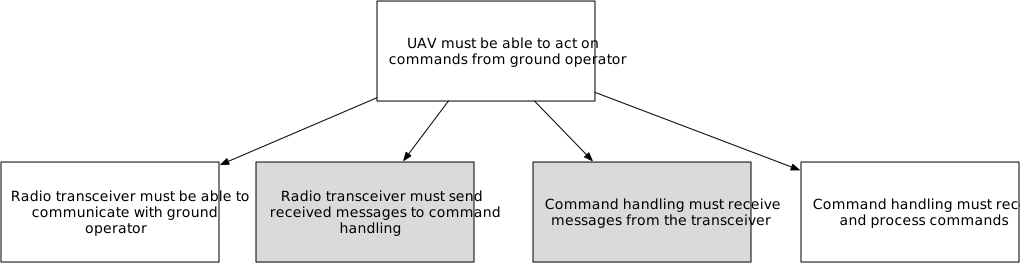
A methodology like this addresses some of the problems with the linear approach. The second iteration in the example involves working on the concept, specification, and designs together. This can mean, for example, refining a first version of the concept by sketching out specification and designs. While sketching them out, the team learns about the component and investigate design ideas to see what choices there are to make, what technologies or subcomponents are available, and begin looking at safety or security issues. By first sketching these without trying to make a proper specification or design artifact, the team can learn about problems that might have caused problems later. At the end of the tasks in the second iteration, the team has a concept that is likely to be feasible, and they have notes or sketches for specification and design. In the third iteration, they can evolve the specification and design sketches into a first draft of specification and design artifacts.
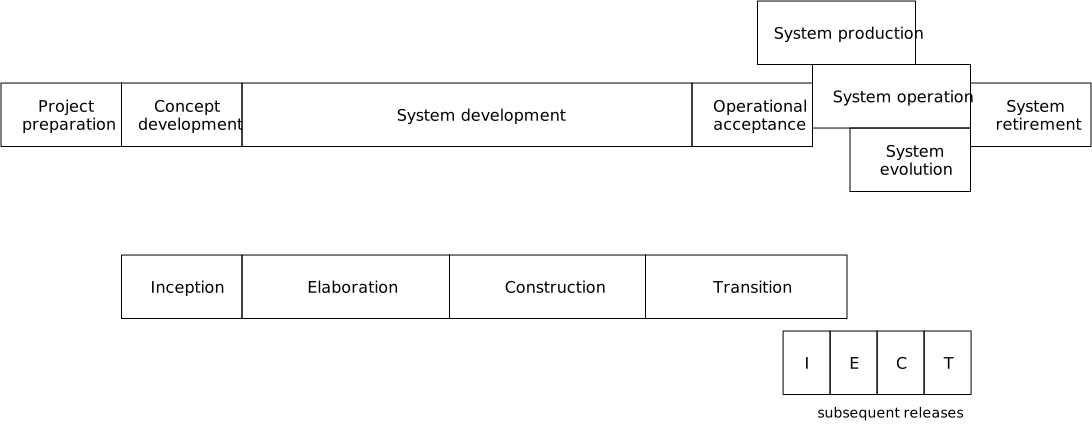
Some methodologies also organize work on related components so they are done concurrently—at least during some iterations. This might be done to develop and verify integration before building out detailed implementations, in order to minimize the risk of finding integration errors late in development when they are more expensive to correct. For example, two components that communicate over a wired connection would be designed at the same time, possibly by one person or possibly by a couple people working closely together. In these methodologies, one often uses mockups and stubs in place of functionality that will be designed and built in future iterations.
Spiral development methodologies, on the other hand, break system development up into large iterations. During one large iteration (one turn of the spiral) a lot of people focus on some shared functionality that touches many parts of the system. In one project involving multiple spacecraft, my team identified several system-wide functional milestones that built on each other, then worked toward one after another. We first demonstrated that we had a working development and testing environment, then built a skeleton of the software infrastructure, then built some simple applications on that infrastructure. This approach incentivized people to work together on shared goals that could be achieved in a month or two, rather than having everyone work in a different direction.
The whole system development effort can be treated a similar way. Most projects have milestones that cut across all the work: early decisions of whether to proceed on the project or not, demonstrations of work in progress for funders, and so on. These can fit into the development methodology by treating those milestones like the endpoints of development spirals.
Summary. This sequence shows how one can start with a component breakdown structure then apply life cycle patterns and a development methodology to work out the tasks that the project will be performing.
This first step has been unrealistic because it is written as if all the components are known at the beginning, and that nothing changes. In the next section I discuss how to handle discovering the component structure and adapting to changes.
21.4 How work grows and changes
In reality, one doesn’t know all a project’s components or milestones at the beginning. They are discovered bit by bit as development proceeds. More work is discovered as problems are found that need to be fixed, or as stakeholders ask for changes.
At any given time, only so much of the system’s structure has been worked out. People will know only a few artifacts that are needed early in the project, and over time they will learn the rest of the system structure.
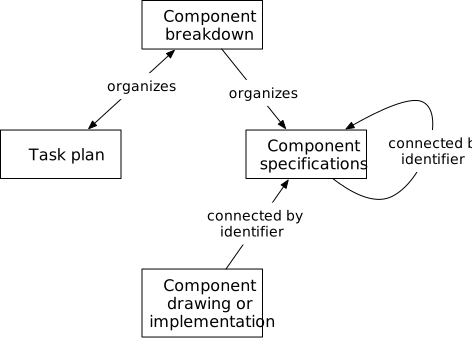
To understand how the view of the component breakdown and associated artifacts changes, consider four scenarios:
- Discovery of system structure as design proceeds;
- Needed rework, because of resource negotiation;
- Needed rework, because of design or implementation problems; and
- Change requests.
System structure discovery. Discovery works generally downward and outward from what is already known. Looking at a component breakdown structure early in the project, one might see the top level system and a few of its first level components; some of the first level components might have some of their subcomponents identified; the rest of the system would be unknown. Work would then add more first level components, flesh out their subcomponents, and begin to work out relationships among the components (Chapter 12). Over time all the components and their relationships get identified.
This means that the high level structure—the top couple of layers of components in the breakdown structure and their relationships—are defined before the details of all those components are worked out. The high level structure is expensive to change once it has been established and other components are defined in its terms. This means that it’s worth spending some time sketching out, modeling, or prototyping some of the key parts of the high level components before committing to their structure.
Consider the evolution of the design for an electrical power system, or EPS, for a small spacecraft. It will be known from the beginning that some kind of EPS is needed—after all, all of the avionics need power. Many of the objectives and constraints are known early on as well, such as the size and volume of the spacecraft, rough mass limits, rough power needs of different subsystems, the mission’s approximate orbital geometry leading to estimates of how much time in sun and how much in eclipse. Several of these will be negotiated and refined as the project goes on, so changes will happen.
After this first step, the high level spacecraft design can be committed, or baselined: the spacecraft will definitely need an EPS and further work can proceed, assured that there will be one. The design of the EPS and the specific demands on it are still unknown, but it is now reasonable to proceed to work to discover that next level of information.
When the time comes a little later to design the EPS, it can then be broken down into a few components, following a common pattern for small spacecraft. It will include solar panels for generation, batteries for storage, a power distribution unit to control how power is used, wiring to move energy around, a safety mechanism to disable all power until the spacecraft has been deployed, a mechanism to permanently drain and disable power, and various sensors.
This collection of components is initially a tentative proposal. The rough design is not yet ready for people to put in greater effort because there are likely many open questions: Are there appropriate parts available? Can the approach meet general requirements? (Launch safety requirements are a common source of EPS complexity.) Can the EPS likely provide the power needed to run spacecraft systems? The team investigates questions like these, typically including modeling the EPS, looking for parts or suppliers, and constructing prototypes.
As these proposed components are tentatively added to the system, they add to a tentative version of the component breakdown structure. This implies that the artifacts involved in those components are tentatively added to the system artifact graph, and the lifecycle patterns apply to create a number of tentative tasks. The result is a large number of tentative artifacts and tasks.
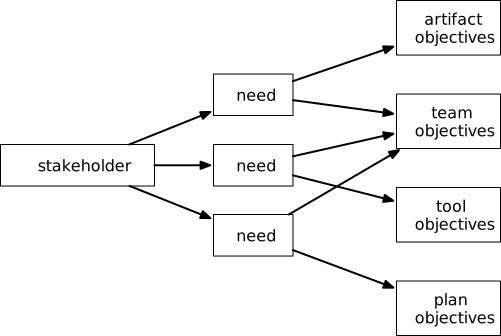
Needed rework due to resource negotiation. Many systems will have some resources that must be shared among multiple components, and the demand from the components must be met by the supply of the resource. Mass, power, bandwidth, and space are common shared resources. A maximum mass provides a constraint on the sum of the masses of all components. The power available at different times must be sufficient to meet what electrical components will use; the ability to generate electricity and the demand for it change as the system goes through different activities. The demand for data transmission is constrained by the capacity of communication channels. Physical parts must be able to fit within the volume available for them. Chapter 45 goes into more detail about these kinds of resources.
Because the resources are shared, a change to one component can affect the others. A component may be designed to meet its specification for a particular maximum mass, for example, but if another component is over mass the properly-designed component’s specification (and thus design and implementation) may have to change to meet the shared constraint.
Consider a system that has fifteen components and a constraint that the overall mass must be less than . Each component is given a specification of its share of mass, . The shares are set so that . (Best practice is to reserve some fraction of as margin, to absorb estimation errors.) As component designs proceed, three components come in over their budgeted share, two well under their share, and the total is more than . The team needs to find savings in some to components bring the total below the maximum. This involves negotiating among people responsible for the different components; the team investigates alternate designs that might reduce mass. The end result is that the specifications for some components will change to give them a lower share , and some overweight components may get a larger share.[1]
The tasks involved can be expressed in a life cycle pattern. The pattern starts with a task to identify and report on the resource problem, followed by investigating and negotiating ways to change resource allocations. The investigation is usually done by people handling multiple affected components working together, not independently. Once the team has found a new set of allocations, it gets reviewed. Once approved, the specification for each affected component is updated and the pattern of tasks for building the component is reiterated. This means that designs and implementations are changed, reviewed, and verified.
During the investigation and negotiation, the team creates several new, tentative versions of component designs. These are typically rough concepts or designs, not fully worked out. They are hypothetical; they represent some way that the team might change designs to reduce resource usage. Some of the alternatives will be no better than the current approach. Some alternatives may use less resource, but come with a tradeoff, such as changing some functionality or moving it to some other component.
It helps the team if they keep track of these hypothetical designs, along with the rationale of why an alternative might be an improvement. If the alternative involves a potential change that will affect other parts of the system, it is helpful to keep track of both how the design changes the component’s specification and what it does to other components. The team uses this information when choosing the new approach for all affected components. They also use this information to update each component’s specification and design.
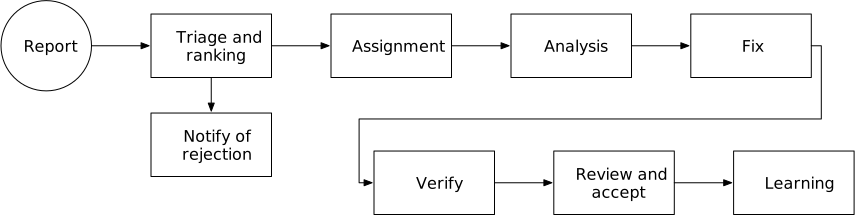
Needed rework, because of problems found. No real team is always perfect; people will find problems in work that has already been done. A project should have a general approach for how people handle finding and fixing such errors.
Dealing with a problem begins with detecting that the problem exists. This might come from observing an error during verification; it might come during a review of a design or implementation; it might come when interpreting a specification to build a design or interpreting a design to implement a component. The people who found the problem create a problem report artifact to record what they have found.
The next step is to investigate to determine where the sources of the problem lie. This might be within the implementation of one component—the easy case—but it might reflect a specification or design flaw crossing multiple components. The example of the Mars Polar Lander loss discussed in [Leveson11, Chapter 2] shows a case where individual components behaved according to their specification, but the components were not mutually consistent. In that case, a sensor could produce transient signals that led the control system to conclude that the spacecraft had landed and thus shut down propulsion; in fact it was still at some altitude and thus crashed. This example shows where a problem results from an incorrect emergent behavior, and and the “cause” is distributed across multiple components.
Following the investigation, there is a decision about how to fix the problem. This might include changing the specification of one component, and changing the designs of a couple others. The decision may include evaluating multiple possible ways to solve the problem before deciding. The evaluation might include prototyping fixes and testing them.
Once decided, the steps to make the changes follow. If the decision is to change a component’s specification, this leads to changes in the design, implementation, verification design and implementation, and eventually verification of that component against the revised specification.
This sequence of events can be divided into two parts: a first part involving detecting a problem and deciding on a fix, and a second part that is a reiteration of the steps involved in making or updating components. The investigation and decision part involves some new artifacts: records of the problem report, of the analysis, and of the decision. The second part involves updates to existing artifacts, starting with whatever artifacts need to be fixed and then following the normal life cycle pattern for building the affected component. The overall flow is similar to that for handling resource overage.
Note that making a change to one component’s artifact usually leads to updating artifacts that follow from it: changing a specification means changing design and verification approach to match. Changing a design means changing implementation. Changes to implementation lead to a need to verify that the component is still correct; this re-verification may continue up through several levels to ensure that the changes integrate properly with other parts of the system. These artifact changes also mean that tasks like performing reviews or getting approvals will need to be repeated, depending on the associated life cycle patterns.
Many times when I have received a software problem report, the problem has been fairly simple. There has been a simple typo in a user interface message, or an off-by-one error in a computation. It hasn’t required a lot of investigation or decision-making about how to solve the problem; it’s a few characters changed in one line of source code. This leads to an abbreviated version of the task flow above: get the report, look at the code, fix the one line, check that it works, done. The tools and processes involved should make easy situations like this easy to handle. In software development, many of the tools streamline these processes: a problem report system connects with a version control system, and the version control system enforces getting reviews and approval before a version is baselined.
At the other extreme, some problems are complex enough that they will need careful analysis first, and implementing fixes will require several people to work together. A simple mapping of the artifacts involved to tasks to update each one doesn’t reflect that some changes have to be done together: co-designing changes to components that interact, for example.
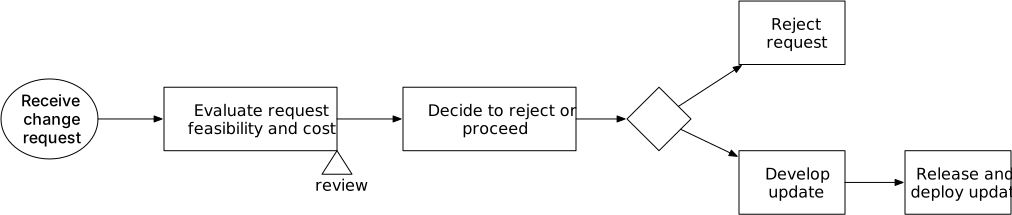
Change requests. When a customer or other stakeholder changes what they need, the system may need to be changed as a result. A request for a change is not an indication that there is a flaw in the system, but only a request for something different than what they asked for before. Changes don’t always happen just because a stakeholder asked; sometimes the project decides not to make the change.
Change requests follow a similar flow to the one for fixing problems. Someone realizes the desire for a change, and creates a change request artifact. The team evaluates the change request to determine whether to investigate the request or not. They then investigate the scope of the change to learn how much work it might be to build; this work often includes (at least informally) creating new versions of the system purpose and concept. The investigation also includes updating analyses to see if making the change will cause problems for other stakeholder needs—for example, requiring more investment from funders to make the change, or interfering with safety or security needs.
The reporting and investigation steps record information in a number of artifacts:

If the team then decides to pursue the change, they begin to do tasks that update the system purpose and concept, flow into system specifications, and so on down to affected components.
Note that by definition change requests from stakeholders only involve changing the system as a whole. The internals of the system are the project’s responsibility, and stakeholders only know about what’s inside when they need to perform some validation activity. For example, certification of an aircraft validates that its design and implementation meet airspace regulations. The regulator only gets to specify the standards an aircraft must meet to be considered acceptable, and on validation they can find that the design does not meet those standards, but the regulator cannot request a change to a specific component’s design (though it may sometimes seem like they do that).
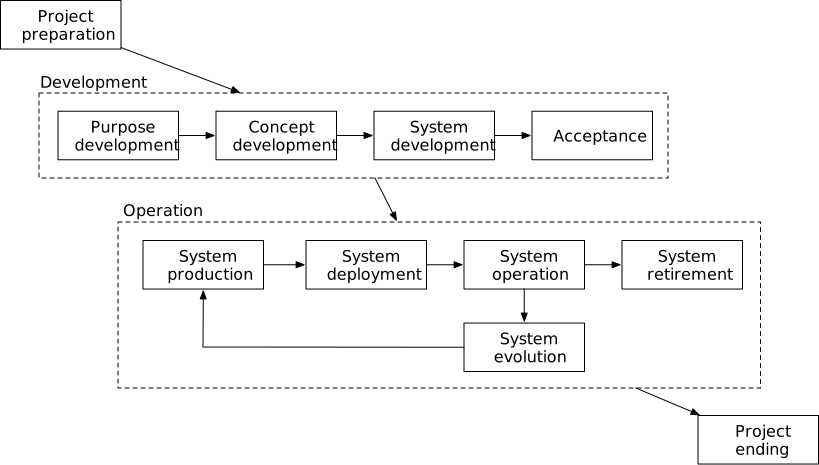
21.5 Managing artifacts
Tasks are for generating output artifacts based on input artifacts. That is, artifacts are the means of communicating information between tasks.
All the work output—that is, artifacts—needs to be stored and maintained to be useful. Those who need a particular artifact as input need to be able to find it, and know what to do with their results. Other people later need to find all those artifacts to check the work or to make changes as the system evolves.
People often work on multiple versions of an artifact while they are working on a task. Someone builds up the requirements for a component step by step until they believe the requirements are complete. Two people might work on two separate alternative designs for a component, and eventually the project decides which design artifact will be used. Two other people might collaborate on a component implementation, sharing updates as they build the component. A group of people might be building component implementations while someone else looks into a change request that will change some of the components’ specifications, and thus designs and implementations. In all these cases there can be multiple versions of artifacts, with some of the versions tentative works in progress while other versions are settled.
When there are multiple versions, people need to use the right version for their task. Two people working together on a component design want to be sharing the same in-progress version. Someone implementing a component, on the other hand, wants to use the current, approved design version—not an out of date version, and not some work in progress that is constantly changing.
More generally, the project can have multiple versions of some artifact at any given moment. Some of these versions will be works in progress; others will be tentatively completed but not yet reviewed and approved. One version might be the stable baseline version. Some time later the baseline version might be replaced, and the old baseline becomes obsolete.
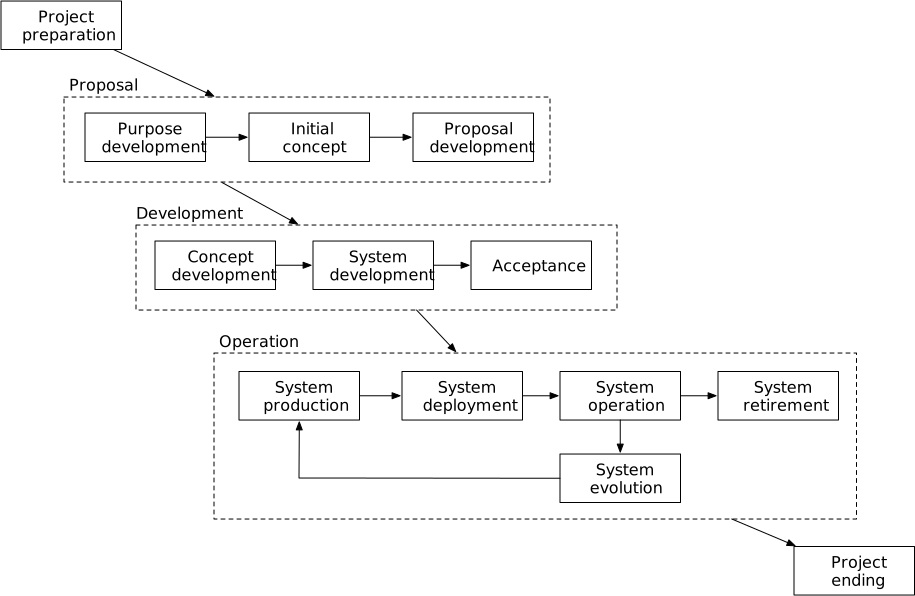
The distinction between artifact versions that are tentative and those that are committed or baselined is how much others can rely on the state of the artifact remaining stable. If artifact A is stable, then someone can use it when working on another artifact B without risking that the work on B will become obsolete because A changes. Using other words, the distinction is based on the uncertainty in A.
Uncertainty is measured in varying degree. One thing can be more or less uncertain than another; almost nothing will be completely certain and few things will be completely uncertain.
An artifact version’s status as tentative or baselined, on the other hand, is a binary condition. The status thus obscures some of the information about a version of an artifact. The status does, however, reflect a decision: whether the uncertainty in a version is good enough for others to work from or not.
Many artifacts need to be consistent with each other. For example, consider the designs of a set of components that work together. Their designs aren’t complete until they are consistent so that each implements the behaviors that others need. If one component’s design changes, the other designs must be at least checked and maybe changed to fit how the one component has changed. To support this, a group of artifacts can be a work in progress, tentative, baselined, or obsolete.
This is similar to techniques used in software version control. In these tools, people make changes to local copies of files, then check the changes in to working branches. The working branches are a view of a new tentative system version. At some point the contents of working branches are pushed to a master branch, representing the committed (baselined) information that everyone is working with. There are usually several independent tentative versions (working branches) being developed in parallel, and they will need to be reconciled at some point. The tools enforce checks and reviews before changes are merged into the master branch (baselined or committed).
While the versions can be managed by hand, today almost all projects use automated tools to coordinate and store artifact versions. Software version control systems and document or configuration management systems provide tools for tracking which versions are available and what their states are.
21.6 Uncertainty and choosing tasks
All of these ways that systems change share something in common: unknowns. While a system is being designed, parts of it will be unknown. When resources need to be traded or when problems need to be fixed, it is not known how the situation can be resolved. Before parts of the system have been verified, there will be flaws, but what and where are unknown.
I have discussed how new work is tentative while it is in progress, and at some point the work is baselined so that others can use that work. Promoting an artifact from tentative to baseline depends on whether that artifact is likely stable enough that changes aren’t going to come along too often, causing additional work on the artifacts that depend on this one. In other words, being baselined depends on how much is still unknown about the artifact.
These aspects of work are reflections of uncertainty. Uncertainty about an artifact is a measure of what is not yet known about it, or what changes may happen in the future.
Uncertainty matters because the areas of uncertainty are where work will be done—and because the amount of work is hard to estimate.
Uncertainty is a normal and inescapable part of building a system. After all, at the start of a project nothing is known about the system that will result except a vague idea of what it might be for. System-building can be viewed as a process starting with everything uncertain, then step by step resolving uncertainties over time as more and more artifacts are understood, designed, and checked. At the end of a project, when a system has been implemented, verified, and accepted, there are by definition no uncertainties left. The challenge is to deal with uncertainties in a way that resolves the most important ones early and keeps the team’s work from becoming chaotic.
Uncertainty takes many forms. Sometimes it is just something that hasn’t been built yet, like implementation of a component. Sometimes it is something deeper, like what some set of components should do or how some key part of the design might work. Sometimes it is whether things will pass verification, especially whether parts will integrate together properly and produce the desired emergent behaviors. Many forms of uncertainty fall into four categories: unknown content, unknown feasibility, unknown errors, and unknown integration.
Kinds of uncertainty. There are many things that can be unknown, and some of them will be “unknown unknowns”—things that one isn’t even aware yet that the things will be needed.
- Unknown content. These are artifacts, or parts of artifacts, that haven’t been built yet. For example, it may be clear that a spacecraft’s power system needs energy storage, but when it hasn’t been specified or designed, that part of the power system is unknown. Or the design of the energy storage may be started, but it has not yet been completed because the safety-related requirements haven’t been worked in or evaluated yet. This is a kind of known unknown: it can be clear when part of an artifact hasn’t been developed yet.
- Unknown feasibility. This occurs when part of one artifact has been developed, and it creates a situation where some dependent artifact cannot be developed. In the spacecraft power system example, the specification may have been written to include a maximum mass constraint and a minimum energy storage amount. When the energy-per-mass requirement in that specification is greater than the capacity of any available storage technology, that specification is not feasible. For another example, the design of the battery and its connectors and wiring might meet specification, but be impossible to manufacture because the wiring is buried inside some structure. This is a kind of uncertainty that one can suspect without knowing that it’s there.
- Unknown correctness or errors. A component can get through design and implementation, but until it has been verified nobody knows whether it actually works. After an implementation passes verification, there still may be errors because verification is a probabilistic evaluation: it can catch many problems but often there is no guarantee that it will ensure that the component will behave correctly in every situation. (Some analytic methods can reach this level of assurance.) Witness the number of flaws found in well-tested software, for example. When verification steps have not been defined or verification has not been completed, the correctness is a known unknown. Verification then leaves some amount of unknown unknowns for the scenarios that have not been checked.
- Unknown integration. Two components can be designed and implemented correctly to their specifications, but not interact correctly. When they are designed, implemented, and verified individually, it is still uncertain whether they will work together. In my experience, many expensive errors in systems come from problems with integration. Interacting components work together to create emergent behaviors (Section 12.4), which arises from the combination of their separate behaviors. These emergent behaviors are verified at higher levels, either by analysis of the components together or by testing them together. Until the higher-level verification steps have been defined and performed, it is uncertain whether the combination of components will have flaws. As with verifying a component in isolation, the verification steps not completed are known unknowns, while unknown unknowns can hide in the set of conditions not verified.
Effects. Uncertainty can lead to problems when people try to build on something that is uncertain, which is why an artifact is not baselined until the uncertainty is low enough. When a specification is uncertain, people will design the wrong thing, and if they proceed to implement that design the amount of work that will need to be retracted and redone increases.
The team can use information about uncertainty to guide decisions about where to spend effort. Consider an artifact A that has some uncertain aspects, and an artifact B that depends on it. Where should effort be spent? This is an example of unknown content.
One possibility is to focus effort on completing A before working on anything in B. This would likely reduce the chances that something in B will get built that doesn’t match A after it has been completed. For example, if the specification for a component is only partly done, the design of that component could go off in some strange direction that doesn’t meet completed specifications. This is an example of how uncertainty in one artifact leads to uncertainty in its dependent artifacts.
However, what if there is someone available who can work on artifact B—the component design? They will be sitting idle until A is complete. A second possibility for spending effort is to have someone work on those parts of B for which A is fairly certain, having informed them what aspects of A are not yet complete. If a component’s specification is incomplete, the next person might work on parts of the component design that won’t be affected by the missing parts of the specification.
If one person works on artifact A to completion and then moves on to artifact B, it is uncertain whether it is possible to build artifact B. For example, someone might work through a rigorous and complete specification for a component—where the specifications call for something impossible with current technology. This is an instance where it is uncertain whether artifact A, the specification, is feasible rather than just about not being completed. To avoid these kinds of problems, people often do some investigating about design or even prototyping before committing to a specification.
Also when someone completes work on artifact A, what are the chances that there are errors as yet undetected in that artifact? A specification might have an inconsistency or a missed requirement; a design or implementation something similar. The uncertainty about correctness leads to uncertainty about how much rework or fixing will be needed.
A final problem comes with integration: when multiple components are being built independently, they often will not interact properly when put together—that is, will not lead to the desired emergent behavior of the components put together. This is an example of uncertainty about integration, rather than uncertainty about content, feasibility, or correctness. Teams often address this kind of uncertainty by co-designing components that will interact, or by mocking up parts of components so the interaction can be checked before investing in finishing design and implementation of other parts of those components.
Estimation uncertainty. The uncertainty discussed here is related to uncertainty in estimating cost or schedule [McConnell09, Chapter 4]. Note that this is the aggregate uncertainty over the whole project’s schedule or cost, not the uncertainty in specific parts of the work. Estimation practices have developed the cone of uncertainty: the way in which the uncertainty about estimates changes over time as more of the system is worked out, and requirements (specification) and design are completed. Studies based on historical experience show that the cone of uncertainty has a 4x range of variability for a well-run software project.

While estimation uncertainty is not the same as artifact uncertainty, there are lessons to learn from estimation. The cone of uncertainty only narrows when the project is well run (the solid lines in the graph above). McConnell gives examples of the kinds of development process mistakes that lead to uncertainty staying high (or increasing), including failing to work out specifications well, having unstable requirements, poor design and implementation problems that lead to errors to fix, and failing to plan the work. Unfounded optimism about the team’s capability or progress and bias about uncertainty often cause problems with estimation. These can lead to a project where the uncertainty does not converge to zero, or even increases (the dashed line in the graph). Similarly, the uncertainty in system artifacts will only decrease in general if the project is run to avoid these kinds of problems.
Ideally, one would like able to measure uncertainty, but it’s generally not possible. Estimation practices for well-understood kinds of projects, such as developing software of a particular kind, can establish a likely lower bound on variability—but that is different from being able to say what and how much uncertainty exists in a specific artifact, or providing a bound for a new kind of system.
Uncertainty thus has to be treated qualitatively. One can usually say that some component has a little uncertainty, medium, a lot, or complete uncertainty. (I have sometimes called this “how scared am I about this?”) That’s enough for making good enough decisions about how to direct work effort.
Note that the known uncertainty can be quite different from the actual uncertainty. Consider two points in time, one a couple weeks into a project and another two months later. At the first time point, the team will still be discovering stakeholder needs and starting to work out the system purpose and concept. There are probably a small number of large uncertainties then: what the system will be like is unknown, and there may be some indication of particular capabilities that may require unknown solutions. Two months later, the team might be will into the system concept and the number of needed technology solutions will have ballooned. It will likely feel like the project has become far more uncertain in those months. In fact all those unknowns were always there but hadn’t been discovered yet; they hadn’t gone from unknown unknowns to known unknowns.
Using uncertainty. I will discuss in a later chapter (Chapter 22) how to use uncertainty to help guide a project’s work. In short, putting effort where uncertainty is greatest is often a good heuristic for choosing what to work on. Where the greatest uncertainty lies changes over the course of a project: early on, it is in developing an understanding of what the purpose and concept are (unknown content). Later, it moves to working out some of the key decisions about system structure and key enabling technology (unknown content and feasibility). As work progresses into design and implementation, the ability of the high-level parts of the system to integrate together become the most important uncertainty (unknown integration).
The choices for development methodology and life cycle patterns reflect how a project chooses to address uncertainty. The heuristic of focusing on greatest areas of uncertainty affects the choice of development methodology, as I will discuss in the next chapter. It affects how the life cycle patterns include checking for uncertainty (or its resolution) in the flow of tasks for building parts of the system.
21.6.1 Uncertainty versus risk
Uncertainties are different from risks (in the project management sense).
A risk is generally seen as “the potential for performance shortfalls, which may be realized in the future, with respect to achieving explicitly established and stated performance requirements” [NASA16, p. 138]. Risks, in this sense, are fundamentally potential: they may or may not happen. Many risks are external to the system being built: the risk that the project will not get funding, the risk that a vendor will not deliver a component on schedule. Risks are generally categorized by the likelihood and consequence of occurrence; they are defined in terms of scenarios that could happen.
An uncertainty, on the other hand, is a lack of knowledge about part of the system or its artifacts: now knowing how to design a component to achieve some behavior, or not knowing what will be in a specification artifact. An uncertainty about a system artifact has in fact happened, even if no one is yet aware of the lack; it is not a potential lack of knowledge. The consequences of that lack may or may not be predictable.
Uncertainty and risk are certainly closely related. It is uncertain whether a risk’s situation will occur (and thus result in the risk’s consequence). An uncertainty will lead to a consequence, even if that consequence is only doing the expected work to complete something.
A team handles uncertainty and risk differently. Uncertainty is handled by working through parts of artifacts where there is uncertainty—prototyping, analyzing, or just doing the work to build and check the artifact. Handling uncertainty is thus a matter of the ordinary work of the project.
Handling risk, on the other hand, is a matter of planning for the potential events. It is like handling safety or security: one starts by working out what consequences (harms) one wants to avoid, then working out the scenarios or conditions (hazards and environmental conditions) that will lead to an event where the consequences happen (accident). One then works out steps the project can take to reduce the likelihood or severity of the consequence if it does occur.